GraphFleet can change channels without leaving Microsoft 365
GraphFleet hides commands in Calendar extensions and can fall back through Drafts, To Do and OneDrive. Its working SharePoint token recovery shows why removing one cloud object is only the start of containment.

GraphFleet can keep receiving commands even after its preferred Microsoft 365 channel stops working. The Windows backdoor starts with hidden data attached to a Calendar event, then falls back through Outlook Drafts, Microsoft To Do and OneDrive. Removing the event alone does not remove those other routes.
Rubrik Zero Labs published its analysis on 30 October, describing a 64-bit implant that uses Microsoft Graph for command and control. The report does not identify victims, establish the initial infection route or quantify deployments. Its strongest live observation concerns recovery: a refresh token embedded in the sample was invalid, but a replacement retrieved from SharePoint worked during analysis.
For defenders, the useful distinction is between stopping one conversation and removing the malware's ability to start another.
The command is outside the calendar view
GraphFleet gives each infected host an identifier and looks for a Calendar event with a subject beginning Sync-, followed by that identifier. Commands sit in an open extension called com.c2.cmd; results go into a separate extension on the same event.
That matters because the event's visible content is not the command channel. Rubrik says the extension data does not appear in Outlook or Teams. Microsoft documents open extensions as a supported way to attach custom properties to resources, including calendar events. The mechanism is ordinary application functionality being used for a malicious purpose.
The implant reads a command and deletes its extension before execution. Most ordinary command text then runs through a hidden cmd.exe window, with output sent back through Graph. A responder looking only at the calendar interface could therefore miss both the storage mechanism and a command that has already been consumed.
Four channels share one purpose
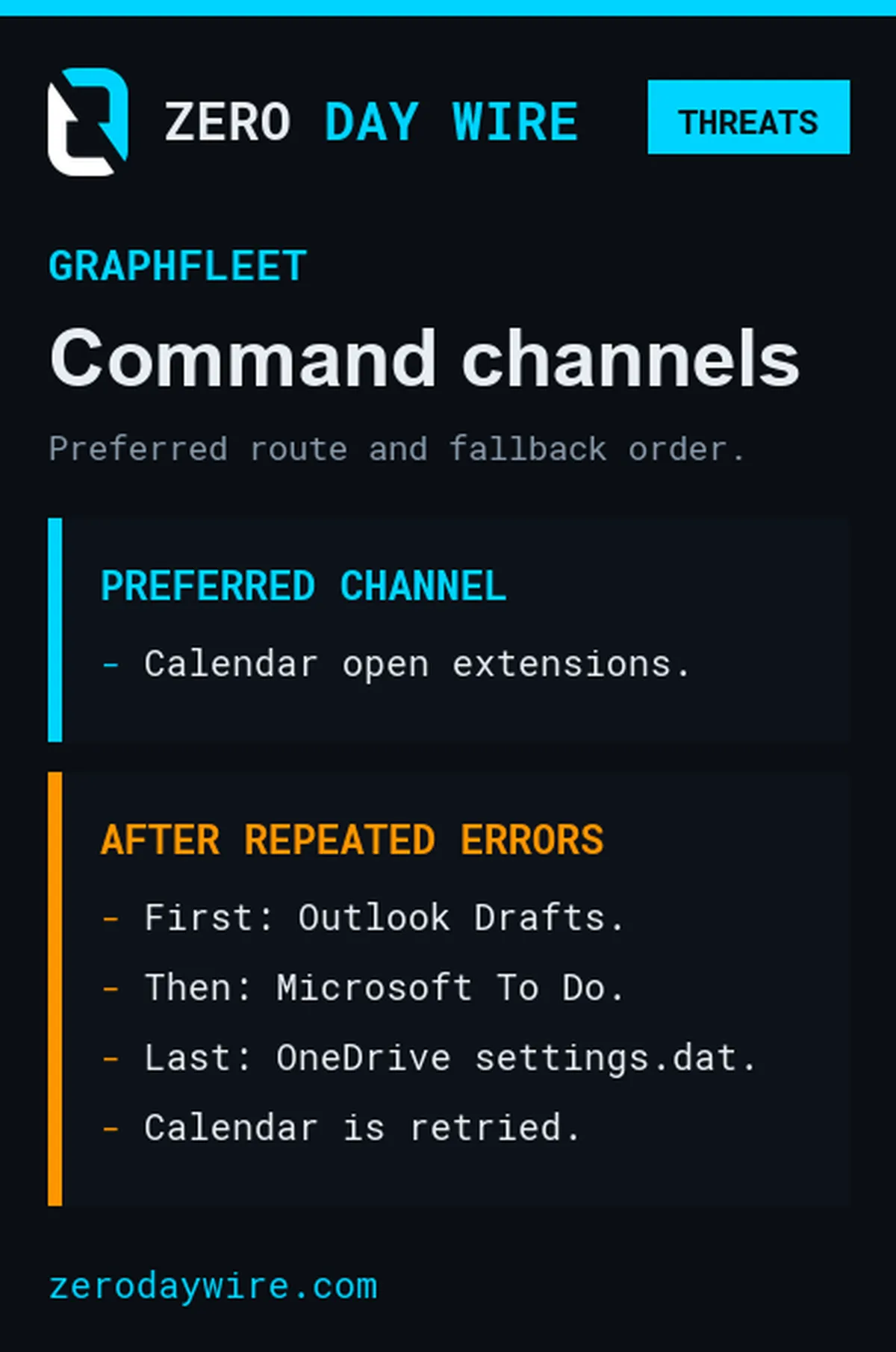
Repeated Calendar errors move GraphFleet to Outlook Drafts. Commands arrive in drafts named cmd-<host-id>, while results use out-<host-id>. It deletes a command draft before running its contents.
The next fallback uses To Do tasks, looking for notes-<host-id> or notes and returning output in notes-done-<host-id>. The final option is a OneDrive app-folder file called settings.dat, which carries commands and results in turn. GraphFleet periodically checks whether Calendar is available again.
These names are useful hunting leads when found together with suspicious execution or authentication. A task called notes or a file called settings.dat is far too ordinary to establish an infection on its own.
The wider lesson is practical. If an investigation finds a suspect event, preserve its extensions and examine the other channels associated with the account. Clearing the first object may interrupt one exchange while leaving the same operator another place to put the next instruction.
Losing a token is not the end
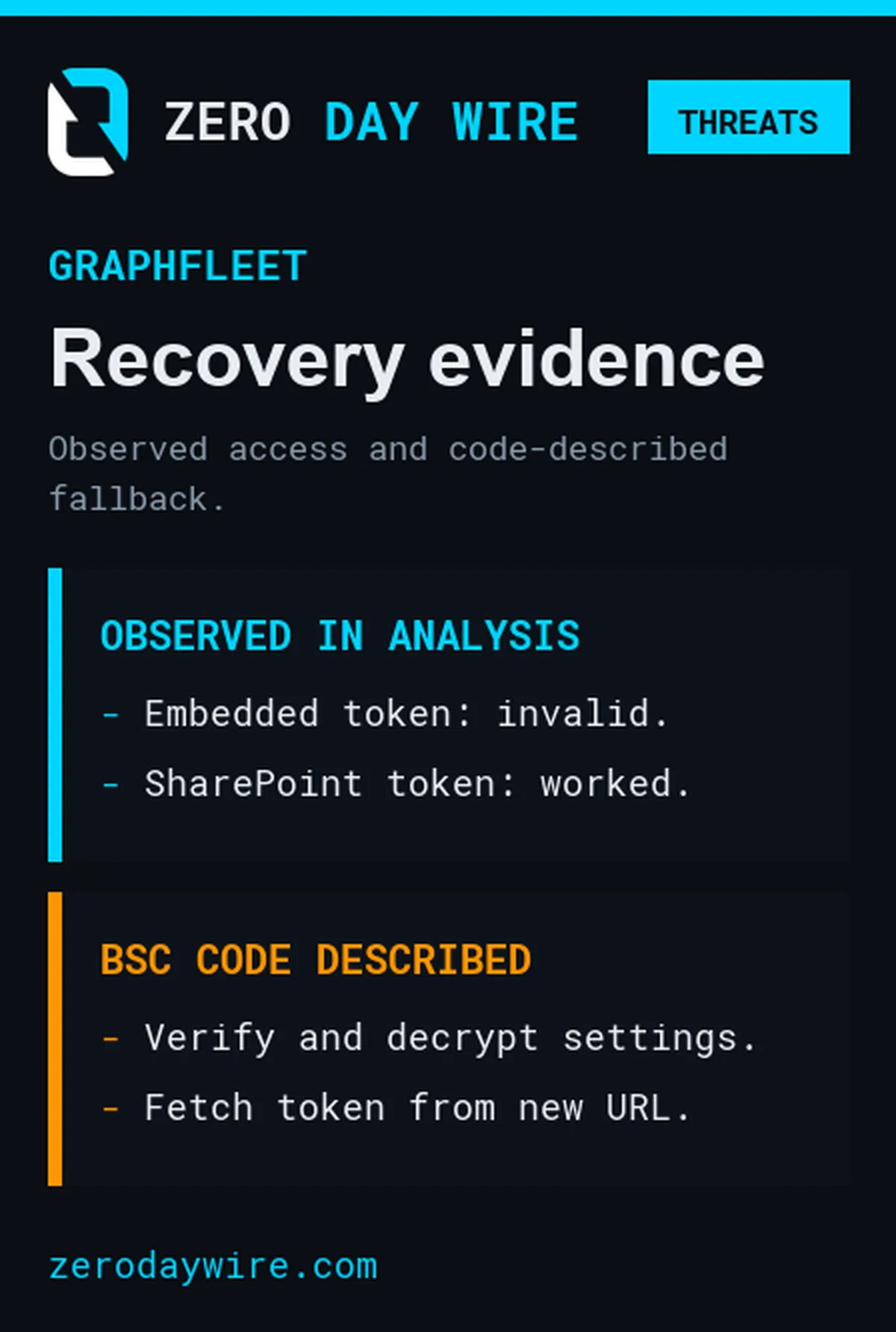
GraphFleet also has ways to recover access. It keeps its latest refresh token in a DPAPI-encrypted local cache at %LOCALAPPDATA%\Microsoft\WindowsUpdate\state.dat. If token renewal fails, it checks that cache for a different token before trying its hard-coded SharePoint source.
Rubrik verified that SharePoint replacement during analysis. The resulting access token identified the application as Microsoft Teams and carried permissions covering the implant's channels. That is a reason to investigate unexpected Teams authentication alongside endpoint evidence, rather than accepting the application name as a verdict.
A further recovery route queries a BNB Smart Chain contract for authenticated, encrypted settings pointing to another token source. The report describes that implementation; it does not say the researchers observed a successful live recovery through the blockchain. Nor does replacement-token recovery demonstrate a bypass of properly enforced revocation. It requires another usable credential.
Microsoft's refresh-token guidance explains why password changes and token revocation should not be treated as interchangeable. Their effects differ by token type and action. Administrators can revoke all refresh tokens for a user, but responders still need to establish which accounts and sessions are involved.
Close every return route
Treat a confirmed GraphFleet finding as an endpoint and identity incident. Isolate the affected host, preserve evidence and investigate the Graph account, its sessions and the cloud objects used for tasking. Do not assume the relevant account belongs to your tenant simply because the infected computer belongs to your organisation.
Check persistence as well. Rubrik describes three user-level startup mechanisms that the implant can repair while a companion .legs file exists. It also describes a print-processor persistence route whose separate mpf64 component was unavailable for analysis. That missing component limits what the report establishes about the privileged route.
Revoke affected refresh tokens as part of containment and verify that access has stopped. Then check for renewed authentication, recreated persistence and activity in the fallback channels. The successful SharePoint recovery is the warning here: a failed token or a quiet Calendar channel can be one interrupted step in a system built to reconnect.