Beget's cloud wipe leaves VPS customers rebuilding from files
Beget says its VPS machine backups were lost while file copies survived. The provider's restart figures show which servers came back, but cloud customers still need to establish what they can rebuild.

Beget says a cyberattack erased data in its cloud services and destroyed the full-machine backups for its virtual private servers. File-level VPS copies survived. For customers who relied on those backups, the question is whether the surviving files are enough to rebuild a working service.
The Russian hosting provider says attackers reached its management servers in the early hours of 2 November, Moscow time, and ran malware designed to delete data. Beget says it disconnected all servers from the network at 02:55 MSK to stop the attack spreading. Its incident timeline gives an estimated time for access to the management servers and does not say how the attackers got in.
What survived the wipe
In its 3 November incident update, Beget said it had lost production data in its VPS, S3 object storage and Kubernetes services, as well as CDN and IP settings. It said its binary VPS backups were lost and pointed to surviving file-level VPS copies as a possible recovery route. It was still looking for ways to recover the other cloud data.
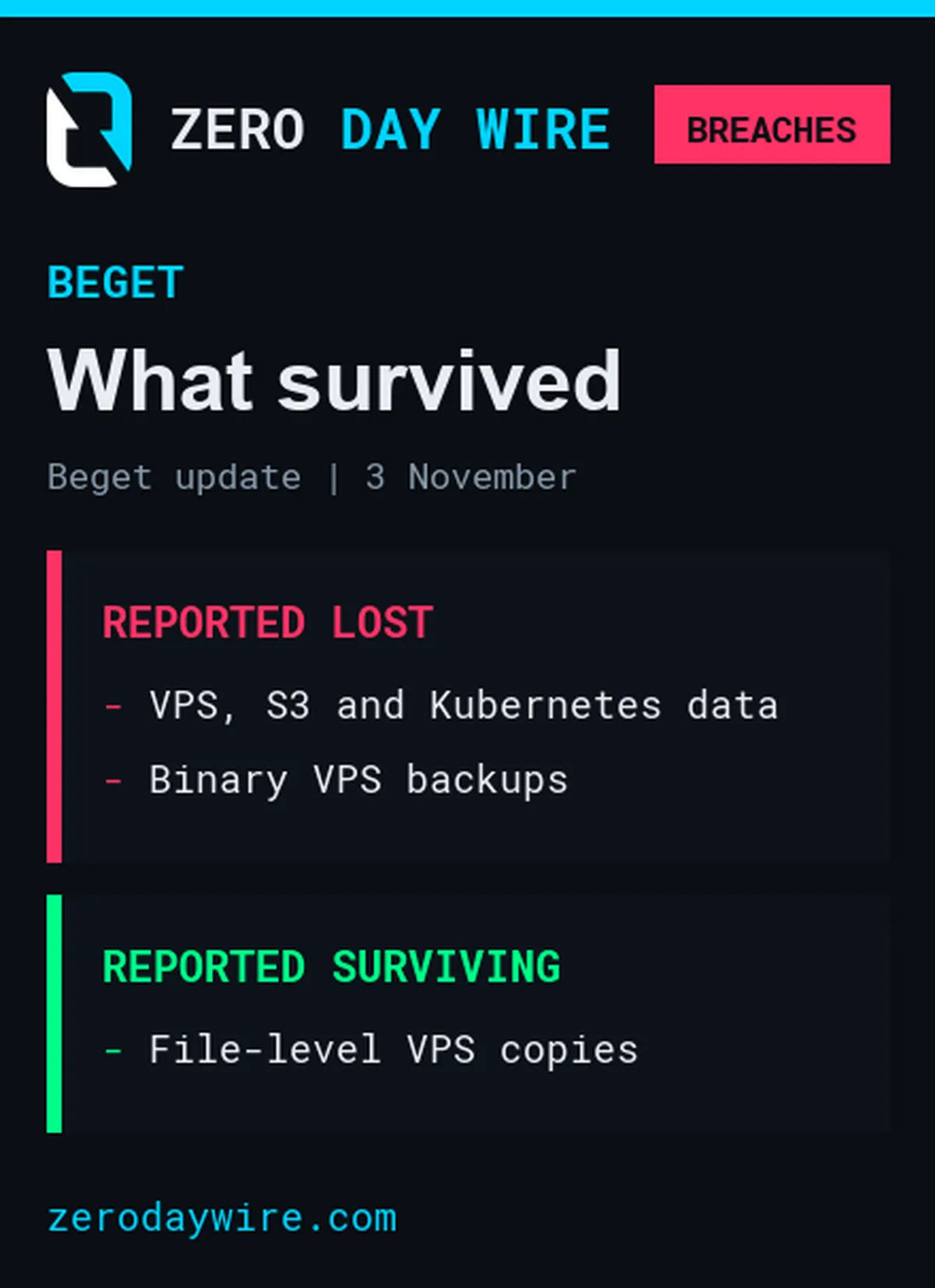
A full-machine backup can give a team a machine to boot. A file copy gives it data to put on a machine it has built. For a VPS that ran a database, the test is whether the available copy can bring up a consistent database. A directory full of database files or a timestamp on an archive cannot answer that on its own.
Beget said it had found no signs that user data had been downloaded or modified on the servers it examined. That assessment remains preliminary. The company advised customers to change passwords, access keys and other credentials that may have been stored on affected servers.
Servers up, backups pending
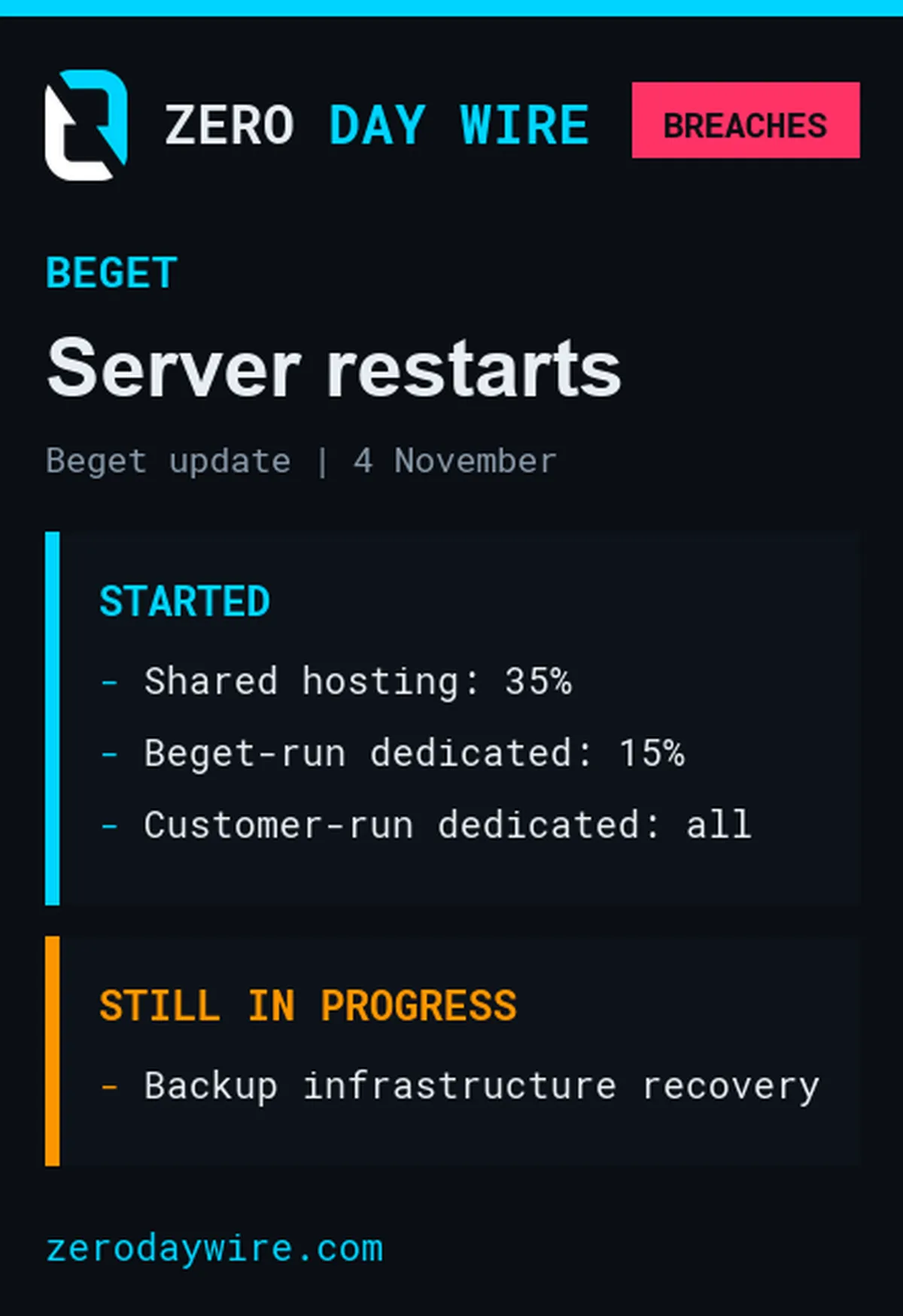
Beget reported on 4 November that it had started 35 per cent of shared hosting servers and 15 per cent of the dedicated servers it administers. All dedicated servers outside its administration were back online. Those figures measure server availability in each service group. In the same update, Beget said its backup infrastructure was still being restored and it would publish instructions for obtaining copies separately.
A restored website may be enough for a shared-hosting customer whose files and database are intact. A cloud customer still needs to establish where each part of the application lives. Check for a usable database export, copies of objects in storage and a way to recreate the deployment and its network settings. Each may have a different recovery point.
Boot from surviving files
When copies become available, start with a clean replacement and restore the minimum needed to test the service. Check that the database opens and that the application can read and write, then check dependencies such as object storage and background jobs before moving traffic. For recovery drills elsewhere, take the provider's control panel and snapshots out of the exercise. A team should be able to name the independent copy it will use, boot a replacement and show that the data still supports the work the service is meant to do.