The Weekend Exposure Check: Cisco VPNs, PHP and Hidden Brotli Copies
Week 44: exploited Cisco, PHP and Brotli flaws lead the handover, with Tailscale privilege fixes and practical checks that prove an update reached the running system.

ZDW Defender's Brief - Week 44, 26-30 October 2026
The uncomfortable question this Friday is whether the update reached everything that actually runs. A PHP version number can hide an older Windows dependency. An application image can retain a vulnerable decoder after its host is patched. An approved SSH connection can reach privileges its policy never intended to grant.
Start with the exploited flaws, then check the configuration and deployed artefact that determine whether the work is finished. Here is the week's handover for the people who have to close those gaps.
Cisco VPN: check the tunnel group
Cisco's newly disclosed CVE-2026-76418 can let an unauthenticated attacker force an ASA or FTD firewall to reload through its SSL remote access VPN. Cisco reports active exploitation; CISA added it to KEV on 29 October. The documented impact is denial of service, not evidence of a code-execution or data-theft capability.
Exposure requires a vulnerable release, a reachable SSL VPN login service and secondary authentication in the relevant tunnel group. When the group list is enabled, inspect every group, including DefaultWEBVPNGroup. With the list disabled, that default group still matters.
Use Cisco's release-by-release fix table to choose the appropriate upgrade. Its temporary measures have conditions: hiding the group list does not remove exposure if the default group uses secondary authentication, while removing secondary authentication lowers VPN security. Make that trade-off explicit if an upgrade cannot happen immediately.
Close-out check: record the deployed release and the tunnel-group review. Investigate unexplained reloads; a reboot alone does not establish exploitation.
PHP: keep three separate jobs open
PHP2Shell's two flaws, CVE-2026-109618 and CVE-2026-109619, entered CISA's KEV catalogue on 26 October. The PHP project lists 8.5.12, 8.4.27, 8.3.36 and 8.2.35 as fixed source releases. Check distribution backports with the package supplier rather than judging an older version string alone. Include appliances whose management interfaces use PHP.
There are two additional jobs. The updated Windows packages are 8.5.12-1, 8.4.27-1, 8.3.36-1 and 8.2.35-1, rebuilt with Brotli 1.2.1. The PHP runtime version stays the same. Reachability through cURL depends on automatic response decompression being enabled.
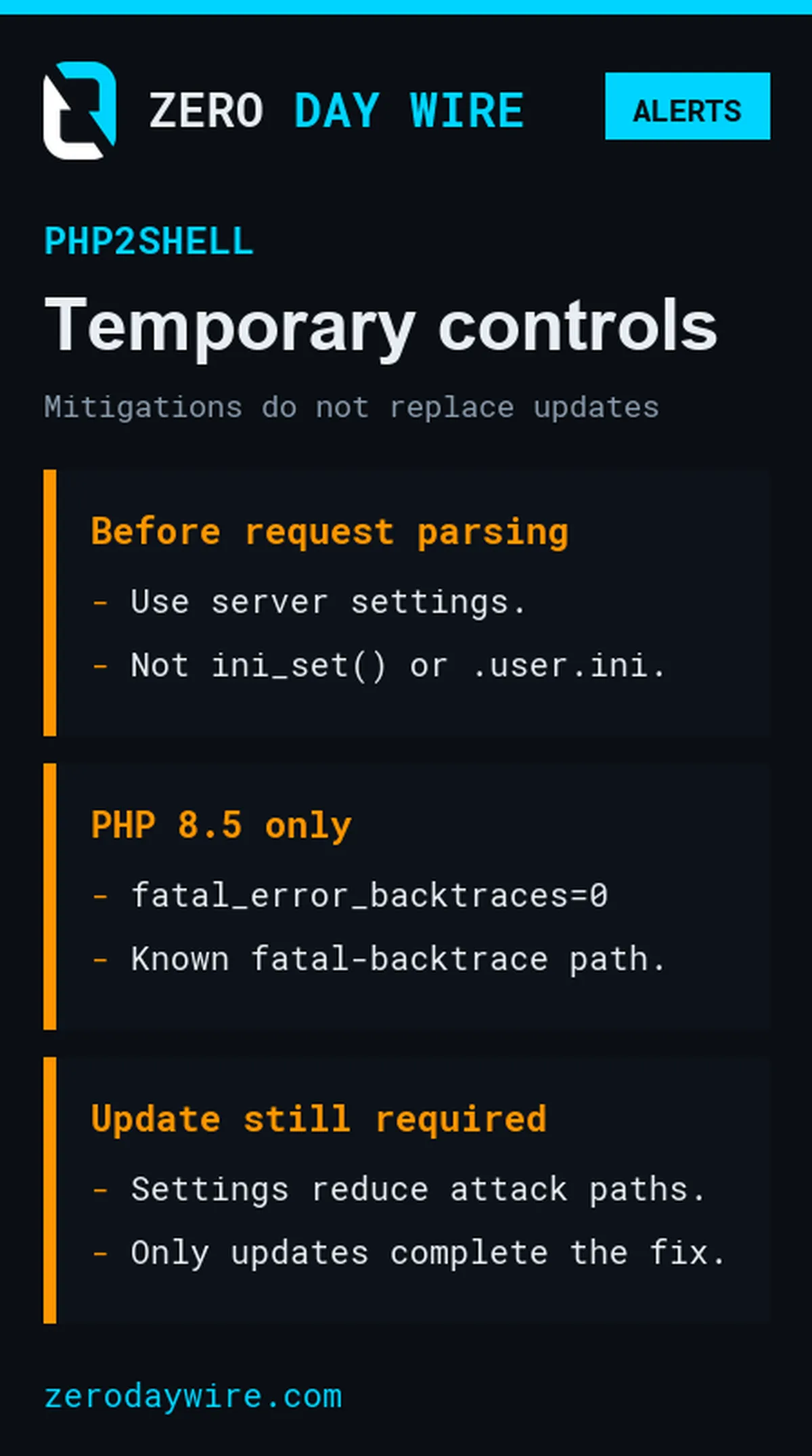
Separately, CVE-2026-115560 remains a conditional, unpatched upload-progress issue in PHP's current notice. It requires upload progress and an application that starts with php_binary or php_serialize configured, then switches to php at runtime before session_start(). PHP recommends session.upload_progress.enabled=0 until the next regular fix; applications that never switch the handler at runtime are outside the described setup.
Close-out check: confirm the effective web-serving runtime and restart workers. Track the Windows package rebuild separately, and retain the upload-progress mitigation where applicable. One completed update ticket does not settle all three jobs.
Brotli: find the copy inside the application
The decoder flaw CVE-2026-111497 entered KEV on 27 October. Node.js describes memory corruption that can cause a crash, disclose process memory or lead to code execution when an application decompresses attacker-supplied Brotli data.
Node.js fixed releases are 22.23.4, 24.22.1 and 26.12.1. Exposure depends on a reachable decompression path; the presence of Node.js does not establish that every application is remotely exploitable.
The operational trap is the copy you did not update. A replacement host runtime does not alter a separately bundled runtime or an already-built container. Find the applications and images that carry the decoder, update the relevant dependency and deploy the rebuilt artefact.
Close-out check: collect the version from the running deployment, not just the build machine. KEV inclusion establishes known exploitation of the flaw; it does not establish that your service was compromised.
Tailscale: review what authorised SSH can reach
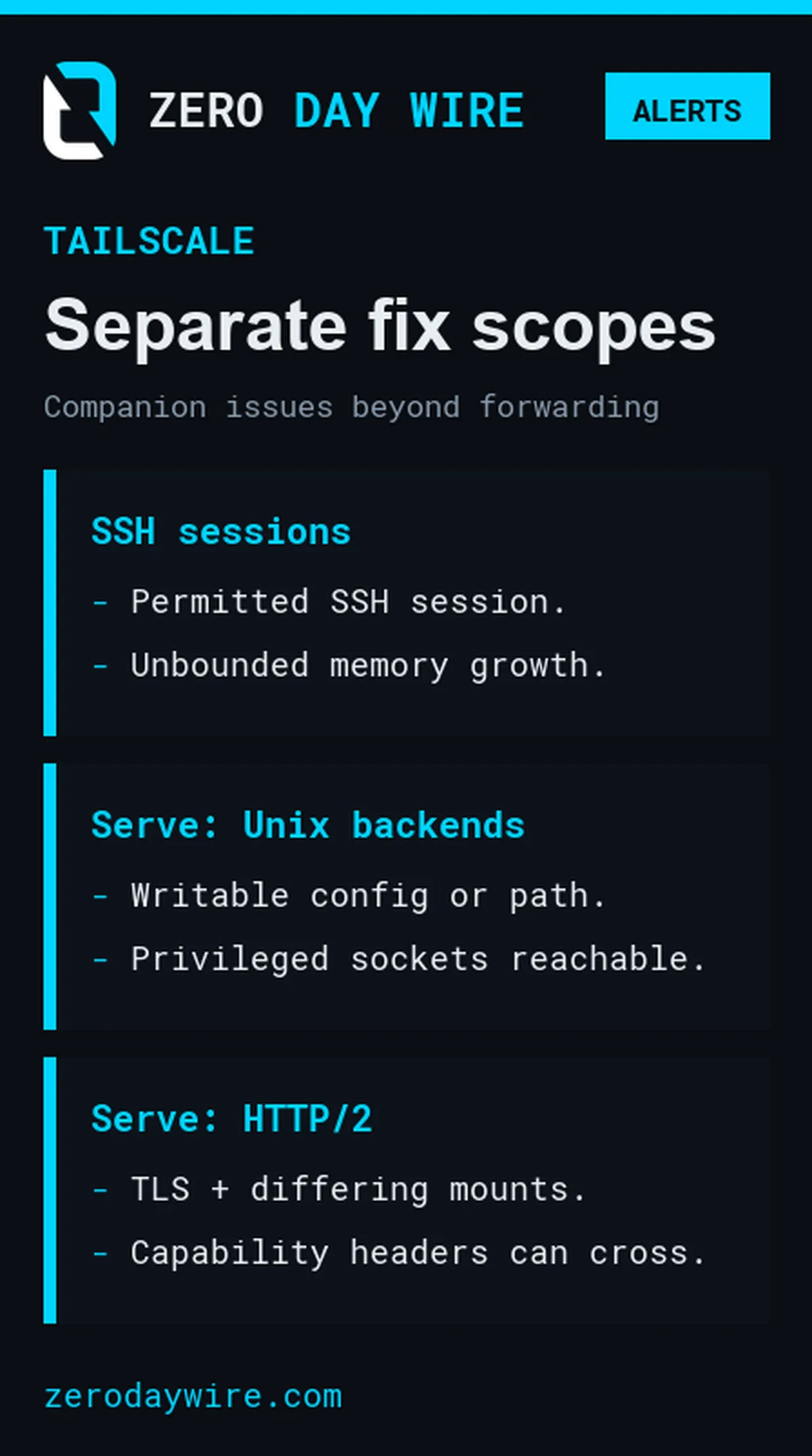
Tailscale's findings and fixes are now available in 1.104.4. Its TS-2026-014 bulletin describes Unix socket forwarding that ran with root privileges, allowing an authenticated peer with forwarding access to reach root-only sockets.
This requires Tailscale SSH and policy-authorised forwarding. It is not an unauthenticated route into every tailnet. The companion bulletins cover SSH memory exhaustion and separate Tailscale Serve weaknesses, so review the features each node actually uses.
Upgrade affected nodes to 1.104.4 or newer. If an update must wait, the forwarding mitigation is TS_SSH_DISABLE_FORWARDING=1 in the tailscaled service environment, followed by a service restart. It disables forwarding without turning off Tailscale SSH; do not mistake it for remediation of every Serve issue.
Close-out check: verify the node version and forwarding policy together. Access granted to a permitted device still needs to respect the local user's privilege boundary.
Keep the wireless and EBS queues moving
HPE wireless: HPESBNW05162 covers AOS-8 and AOS-10 flaws, including eight scored CVSS 10.0. The affected model list is not exhaustive: map conductors, controllers, gateways and access points by software branch. HPE lists fixed releases 10.8.1.2, 10.7.2.7, 10.4.1.14, 8.13.3.1 and 8.10.0.24. Restrict management access while arranging upgrades. HPE's statement that it knew of no public exploit code or discussion is dated to its 22 October bulletin, not a guarantee about today's activity.
Oracle E-Business Suite: the October Critical Patch Update addresses CVE-2026-101767 in versions 12.2.3 through 12.2.15. Discoverer Horizon3.ai describes unauthenticated SQL injection through /OA_HTML/AppsTCFServer and a chain to command execution. Apply the installation's applicable patches. Horizon3.ai also recommends restricting the web tier and removing that servlet from the URL firewall allowlist while patching is pending. Its demonstrated chain does not establish a compromise of any particular EBS customer.
Put the identity change in the diary
Microsoft-provided SMS and voice delivery in Entra ID retires on 1 February 2027 for most users. Global Administrators and external users follow on 1 July 2027; internal guest users remain in the February group. Those are different populations, not interchangeable descriptions of guests.
Identify people whose only available MFA method is SMS or voice, then organise replacement registration and help-desk support. Microsoft documents a blocking passkey-registration flow for affected users left with only those methods after retirement. Treat this as planned migration work, separate from today's exploited-vulnerability queue.
Action Items
- Put reachable, affected Cisco VPNs and web-serving PHP systems at the front of the queue, alongside applications that expose a vulnerable Brotli decoder.
- Close each change with evidence from the running system: configuration, deployed release, rebuilt package or image, and worker or service restart where required.
- Give Tailscale, wireless and EBS work named owners. Keep the Entra migration on a dated plan rather than letting it disappear behind emergency patching.
Before handing over for the weekend, ask one last question: what proves the vulnerable code is no longer the code your users are reaching?