VOLTA can steal the credentials before its AI assessment runs
Talos's VOLTA analysis separates initial theft from optional AI assessment. A refused model request or missing AI report cannot establish that earlier data stayed on the endpoint.


VOLTA's AI feature is easy to mistake for the point where the damage happens. Cisco Talos's 31 October analysis describes a Windows infostealer that can send an initial theft archive before its optional model-assisted assessment. A rejected AI request therefore cannot establish that the stolen material stayed on the computer.
That is a reading of the analysed sample's workflow, not a report that every stage ran against a known victim. The publication does not establish a victim count, campaign prevalence or initial infection route. Its useful defensive lesson is narrower: investigate the collection, external assessment and account access as separate boundaries.
The first archive matters
Talos identifies three possible exfiltration packages. volta_log.zip follows the stealer's collection, volta_dox.zip carries the identity report and AI output, and volta_doxnet.zip is associated with network enrichment when that produces results. These are described output stages, not three confirmed transfers in a published victim incident.

For an analyst, that changes the question attached to a blocked AI connection. A record showing that a request to a model service failed is evidence about that request. It does not retrospectively cancel earlier collection or an earlier transfer. Equally, finding a filename in code is not proof that its archive was created or sent. The execution evidence still has to establish what happened on the affected system.
The same caution applies when searching for the AI-generated report. Its presence could help explain how far the workflow progressed. Its absence cannot settle whether the earlier stealer stage succeeded. Treat the stages as questions to investigate, rather than making the most conspicuous feature a shortcut to the whole incident's outcome.
The assessment is optional
The sample builds Identity_Report.txt and receives the model response as AI_Analysis.txt. Talos describes an optional integration that can run without the LLM stage when no AI key is configured. It also identifies fallback handling when a model appears to refuse the request.
That makes the AI layer a poor containment milestone. A defender does not need to demonstrate that a model produced a useful assessment before responding to evidence of credential or session theft. Nor should an unsuccessful assessment be reported as an unsuccessful infection. Keep those conclusions separate in the incident record.
The model-service connection also needs context. Talos says the sample's observed endpoints belong to third parties. A legitimate provider's domain is not an attacker-owned indicator, and a connection to it alone does not identify VOLTA. Correlate the initiating process, surrounding collection activity and timing before drawing a conclusion or applying a broad network restriction.
Read the browser launch
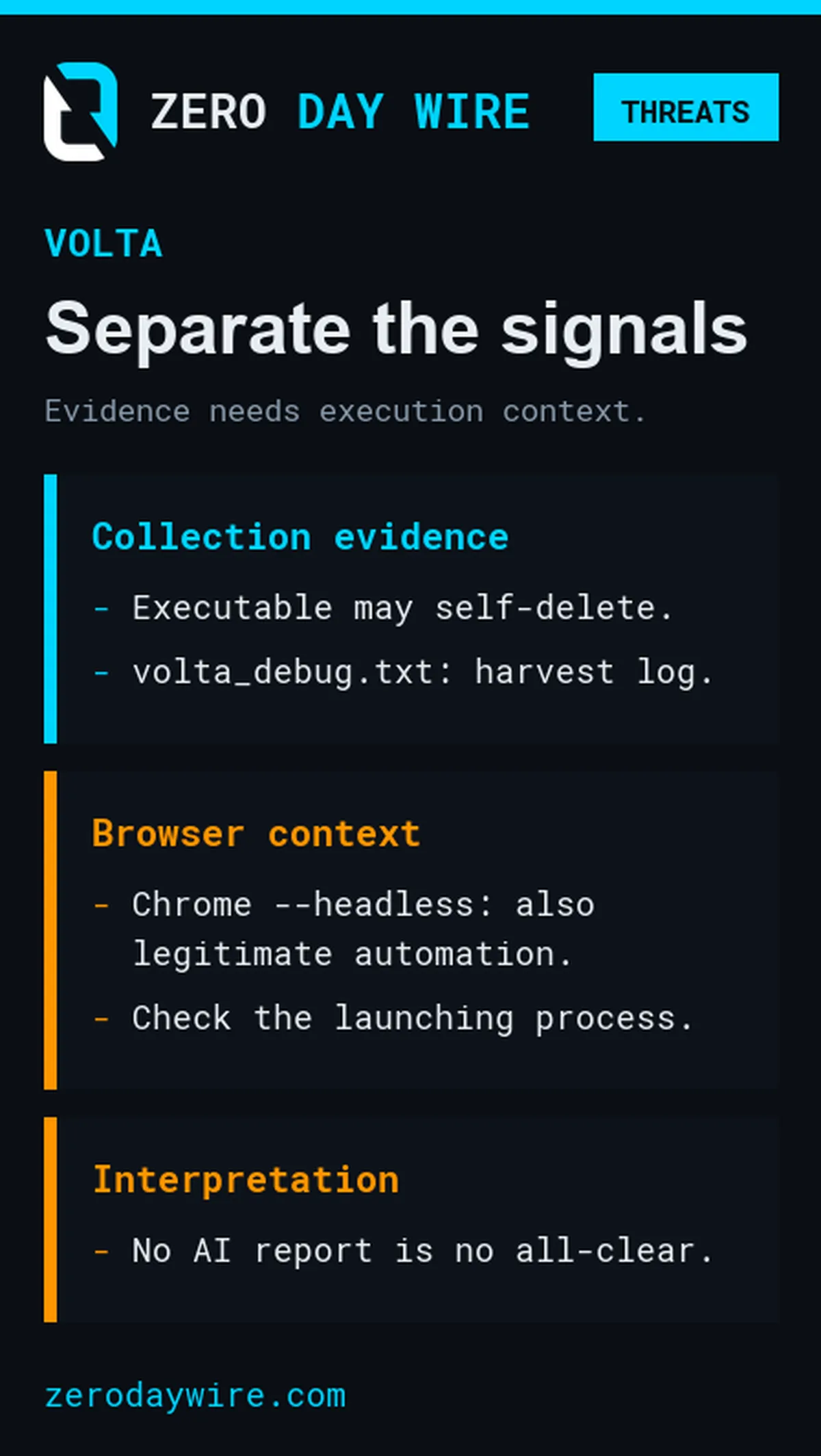
Talos recommends restricting which processes can launch Chrome with --headless to interrupt the App-Bound Encryption decryption path it describes for VOLTA. That is a finding about the analysed implementation, not a claim that the flag universally defeats Chrome's protection.
Chrome's own documentation describes Headless as an unattended browser mode and documents its use in automation tools. The flag is therefore useful investigative context, rather than a malware verdict.
For a managed estate, start by identifying approved browser automation and its expected launchers. Then investigate departures from that baseline alongside the endpoint evidence. A new browser process started by an unexpected executable deserves a different assessment from a known test job running through its normal service account. Test any restriction against the work the organisation actually runs.
Contain the first theft
Talos says the executable can delete itself and points responders to a timestamped volta_debug.txt harvest log recording collection and AI-call status. Preserve relevant evidence through the incident-response process. Such a log can contain sensitive material; keep it in the controlled investigation rather than copying its contents into a general ticket or a public report.
Where endpoint evidence supports theft, contain the system and review the potentially exposed accounts and credentials. Perform account recovery from a clean device. Do not wait for an AI report to decide whether access needs revoking, and do not assume that deleting the executable reverses the access already obtained.
Google's account-access guidance distinguishes devices from sessions: one device can have several sessions, and an unfamiliar session can be signed out individually. It also explains that a displayed activity time can reflect background synchronisation. Review the details before treating a timestamp or a repeated device name as evidence of another attacker.
Apply the relevant issuer's recovery procedure to each affected service and check whether access has actually ended. Record what the endpoint evidence establishes, what the account records establish and what remains unknown. VOLTA's optional AI assessment may add an analyst for the criminal; the defender's job still begins with the theft that can precede it.