SplitBench's 98.7% grader agreement leaves out 26 comparisons
Two graders agreed on 1,356 of 1,374 comparisons in the SplitBench study. Seven other attempts exposed a conversion error that the headline rate cannot show. Here is what to ask for before signing off an agent test.

On seven attempts across two tasks, a new grader rejected the files that researchers wanted it to assess. Those seven attempts appear in the SplitBench preprint. They sit outside its most striking number. When both graders returned a verdict on the same work, they agreed 98.7% of the time. Anyone using that number to sign off an internal test has a good reason to ask for the missing cases as well as the results.
Nathan Nour Houlamy and colleagues set out to answer a problem familiar to anyone who has reviewed a change alongside the tests that supposedly prove it works. A coding agent does its work inside a test environment. If that same environment gets the final say on whether the work passed, a green result may reveal less of what actually happened than a reviewer thinks. SplitBench moves the decision to a separate grader. The authors wanted to see how often that grader would reach the same decision as the original one.
Where the comparison starts
The team began with 202 tasks drawn from two benchmarks. A task is a piece of work set for an agent. An attempt is one run at that task. The difference matters because the study lost cases at both levels.
The researchers converted 68 of the 89 tasks in Terminal-Bench 2.0 and 112 of the 113 in DeepSWE v1.1. That gave them 180 tasks they could run under SplitBench. A terminal task might ask for a service to be left running, or for a program to finish within a particular time. Some such requirements fell outside what the framework could grade. Other exclusions had different causes. In each benchmark, for example, there was a task where the reference solution failed its own tests.
Then came a second cut. After an attempt was graded in the environment where the agent had worked, the researchers gave the other grader a copy of the files it left behind. On five converted tasks, copying those files lost something the original tests needed. The authors give three examples: a server left running, software installed elsewhere and file permission bits. SplitBench could still grade those five tasks. The researchers could not use the copies to compare that verdict fairly with the original grader's.
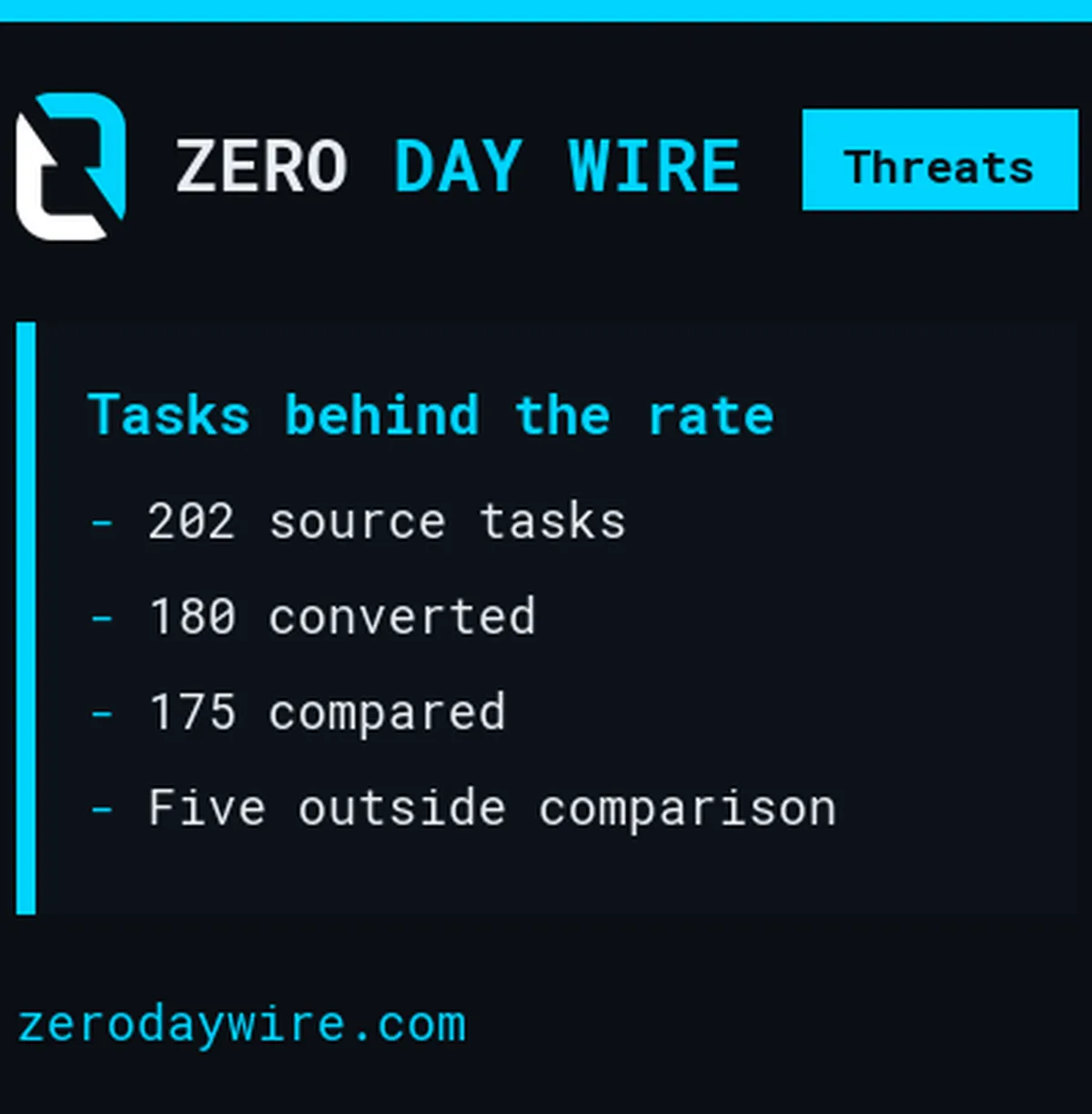
That leaves 175 tasks in the comparison. For a team assessing an agent that changes live services, the five are worth looking at. A directory of finished files might tell you what the agent edited. It cannot, on its own, tell you that a service was still running when the test ended. Before accepting such a result, ask what the test recorded at the time that would let another engineer check it.
The seven that did not count
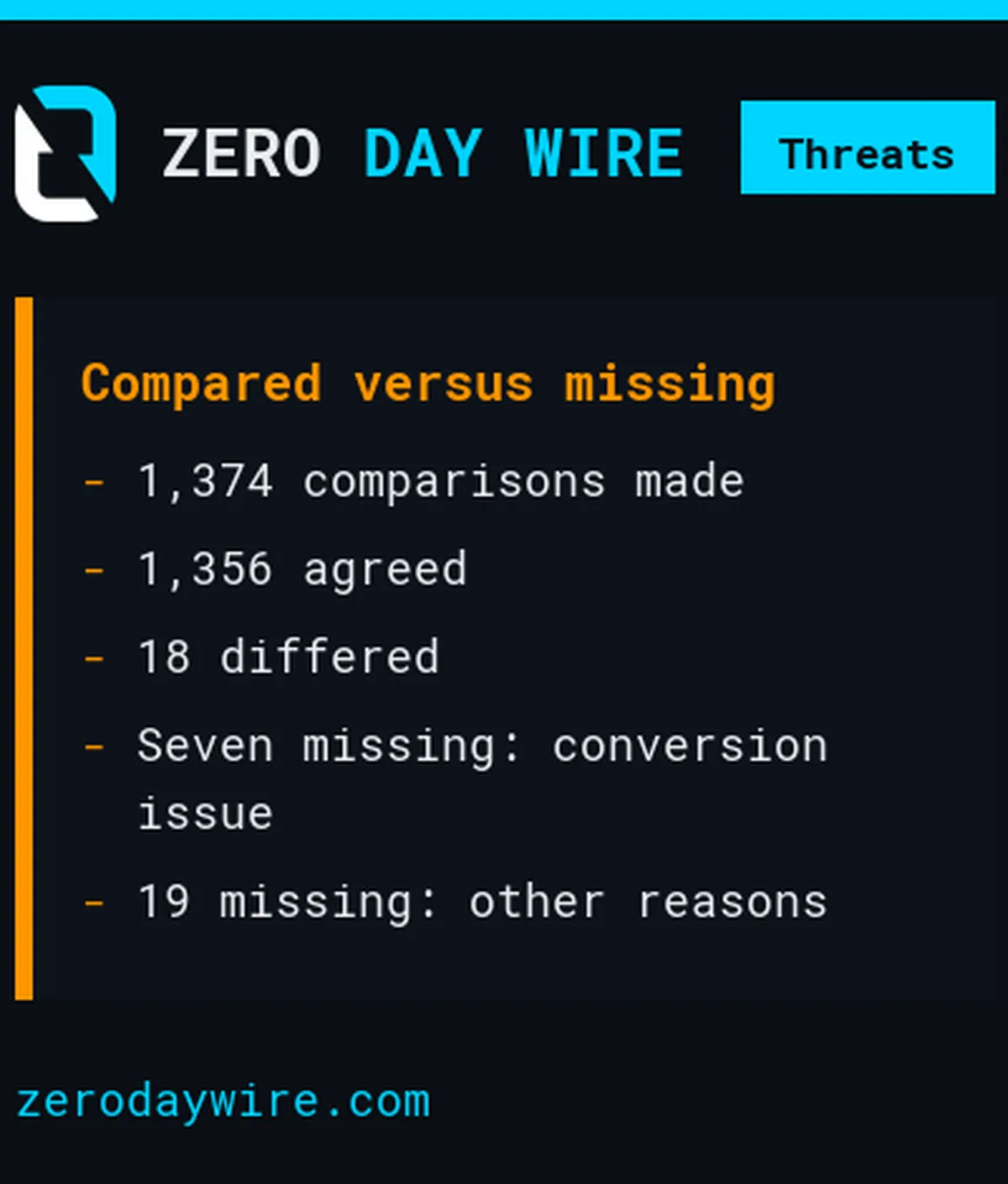
The researchers ran two agents and graded their attempts on the same files. Table V and the text immediately above it put the denominator at 1,374 comparisons with a verdict from both sides. On 1,356 of those, the graders agreed. They disagreed on 18 others. Agreement includes cases in which both graders failed the work. It tells us how often two judgements matched.
Seven additional comparisons involved files containing symbolic links. A symbolic link points to another file or location. Two of the converted tasks rejected these files outright. The researchers attribute both rejections to the same conversion error. Across seven attempts, the results therefore contain no pair of judgements to compare. This matters because counting disagreements alone would miss a known problem in the conversion.
A further 19 comparisons were unavailable for other reasons. The paper gives examples including tests that hung under both graders and attempts that a provider's safeguards refused. It gives no separate number for each reason. Adding seven and 19 yields the 26 missing comparisons in our headline. Scoring all 26 as failures would invent verdicts the experiment never produced.
What the disagreements show
Where two verdicts did exist, the researchers could explain why they differed. Five disagreements came from one task where the original grader treated a test crash as a pass. Twelve involved differences in the tests that the two graders ran. The final disagreement involved timing: the same files could pass or fail a test depending on the order in which parts of the program ran.
Those explanations matter to an engineering lead who has to act on a disputed result. A green tick from a crashed test calls for a correction to the grader. The test and the program need further investigation when results depend on timing. A rejected set of files needs an explanation of why the test could not consider the submission at all. Rolling all three into a single success rate would give the person doing the follow-up very little to work with.
Keep the missing cases
If a supplier cites grader agreement in support of a purchase or deployment, ask for the task list, the reasons for exclusions and the paired verdicts on the work that remained. Ask, too, for every attempt missing a paired verdict, with the outcome recorded on each side. That request would reveal the seven rejections in SplitBench even if the other grader's result were unavailable. A table with only complete pairs could be entirely accurate and still leave them invisible.
There are two different checks a reviewer might want to make with those records. One is to check the verdict on work already produced. The authors say their grading decisions can be recomputed from stored evidence without calling a model. Their open science statement promises the full set of records and a script for recalculating Table V upon publication. The other is to run the agents again and see whether they produce that same work. The paper says the models used were closed and their behaviour varied between runs. Even a reviewer who can reproduce the arithmetic has learned nothing yet about whether a fresh run will follow the same path.
The authors set out those limits in their preprint. A security team can carry them into its own acceptance tests. Pick a task that matters to the deployment. Inspect one paired result and one missing result, if there is one, and ask what evidence survives for each. That gives the sign-off meeting something more useful than a percentage: a record of what the team can actually check.