A former Mail Shonin client says the supplier kept its 38 book buyers' addresses after the contract ended
A Japanese business says Mail Shonin still held 38 book buyers' email addresses after its 31 October contract end. As of 23 November, the operator's third report (18 November) does not address former customers. Ask in writing what a supplier kept.

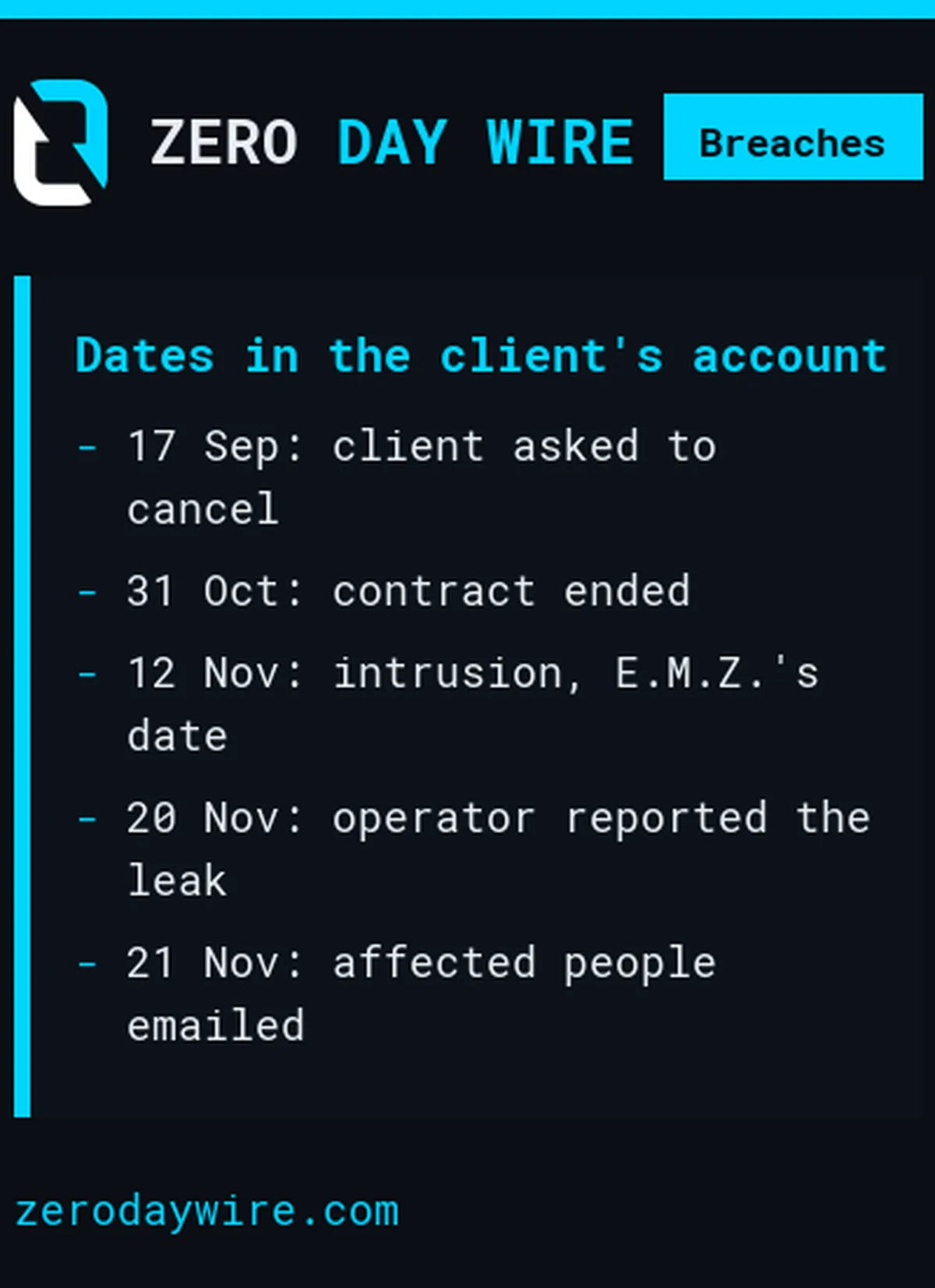
A Japanese business called Online Counselling Kagayaki says the bulk-mail service it had already left still held the email addresses of 38 people who bought its book, and that those addresses were caught up in the breach. It says it contacted Mail Shonin requesting termination of its contract on 17 September 2026 and that the contract ended on 31 October. In a notice dated 21 November, which gives a date and no time, it says the operator, E.M.Z., had retained the registered information "for a certain period" after cancellation.
This is the client's version of events, and it is the only source for the retention. E.M.Z.'s 18 November report speaks of its customer companies and does not mention former ones. The client's claim is therefore unaddressed by the supplier, not contradicted by it.
What the client says it was told
The notice says the business learned of the leak of registered email addresses through a report by the operator on 20 November. It sent out a notification to the people concerned by email the next day, 21 November.
The client says the only information it had registered was the email addresses of people who had bought its book, 38 in all. It says it had not registered names, postal addresses, phone numbers or card details. The notice describes book buyers. It does not describe any counselling records as being registered with the service.
The client says it has requested the deletion of the registered information from the operator. It also says it agreed to jointly submit a report to Japan's Personal Information Protection Commission, and that the reporting procedure is under way. To the buyers, it warns that the addresses could be misused for spam or phishing, and advises caution when clicking on links within suspicious emails and entering personal details.
What E.M.Z. has and has not said
E.M.Z.'s third report was released on 18 November at 16:05 (the page's own time stamp). It dates the intrusion to 12 November. It says the third party took recipient-list data out of the system, and that the text of bulk emails customers had sent was also exported. It says the number of affected customer companies and records is expected to rise significantly compared to the figures it gave on 13 November. The report says E.M.Z. is examining the registered recipient information of all customer companies, and that a customer who has not received contact from it individually should not read that as no impact. It adds that finishing containment does not mean the stolen data has been recovered or its use prevented.
E.M.Z.'s 18 November report does not discuss former customers or state a post-contract retention period. It remained the newest security report listed on the company's public news page at 11:50 UTC on 23 November. It does not resolve the former client's claim about data kept after cancellation.
This represents a different question from the one addressed in our 21 November article. That piece focused upon the Waseda Institute for Advanced Study, an active customer with 708 addresses and exported past mailings. This one involves a customer that had already left.
What the notice leaves open
The retention period is the first gap. "A certain period" is the client's term, and the notice does not convert it into days or months. We cannot say whether E.M.Z. uses a standard period, whether it applies to every account or whether it varies depending on data type.
The second gap is timing. The client gives 31 October as the contract's end. E.M.Z. gives 12 November for the intrusion. That is 12 days later. If the intrusion date applies to these addresses, the account provided by the client implies they were still held then. Neither source says when the addresses were taken.
The third gap relates to content. The notice names email addresses as the registered data. It does not say whether messages the business had sent using this service were also kept or exported. E.M.Z.'s report says exported message bodies were identified for customers, but it does not say which customers, and the client does not say.
The fourth is how the client's addresses came to be treated as in scope. The notice says E.M.Z. reported the leak to the client and that the retention is why the addresses were included, but it does not describe what E.M.Z. presented to it. The 38 is the client's figure. E.M.Z.'s 18 November report does not give this client's count.
The case says nothing about scale. One notice does not tell us how many other former customers had data kept, or whether any did. It shows only that one did, by its account.
Questions for a supplier you have left
Start by examining your own records. Find the date you requested cancellation, the date the contract ended and any message that says your data was deleted. The client's dates show that the first two can be weeks apart. In our view, confirmation of cancellation tells you the account has been closed, not what happened to your lists.
Then write to the supplier and request five things, in writing, so the answer is a record you can keep:
- What did you keep after our contract ended?
- Which lists, and which sent messages, does that cover?
- For how long did you keep them, and why?
- Have you deleted them, and on what date?
- Were they inside the scope of your current incident?
For Mail Shonin, the support desk can be found at the bottom of E.M.Z.'s 18 November report, with weekday hours in Japan time. Because a customer's notice does not constitute a supplier's statement, ask for the supplier's own answer.
Keep the supplier in your incident response until it replies. In practical terms, leave the vendor open within your register and revisit any statement, such as "not affected because the contract ended", that assumed leaving settled the matter.
If the supplier confirms it held your lists or sent messages at the time of the intrusion, ask whether those records were exposed. Retention alone does not answer that question. If it confirms your records were affected, explain to subscribers what is known: which fields, what misuse to expect, and what remains uncertain. The client says it received a leak report on 20 November and notified the affected people the next day. A written deletion date before 12 November along with a statement that you are out of scope would let you close the item. Silence, or an answer that gives no date, leaves it open. The client's notice reports no credential problem, and its registered data was addresses only. E.M.Z.'s 13 November report put administrator credentials at risk for 170 customer companies, as our 21 November article noted. That report does not say whether former customers were among them, so a former customer should still ask.
Ask for the deletion record
The 38 addresses are a small number, and the evidence is one notice. What carries over is the habit of treating cancellations as events in your own files and deletions as something the supplier has to show you. The client says the supplier reported the leak on 20 November, 64 days after its cancellation request. Those who have left Mail Shonin or another bulk-mail supplier can ask these same questions now, before a breach notice makes them urgent.