QuickBooks phishing returns through a familiar mail tracker
A QuickBooks callback scam resumed after a provider suspended its account. Infoblox's wider investigation also shows why a signed app inside an unsigned installer proves little about the package.

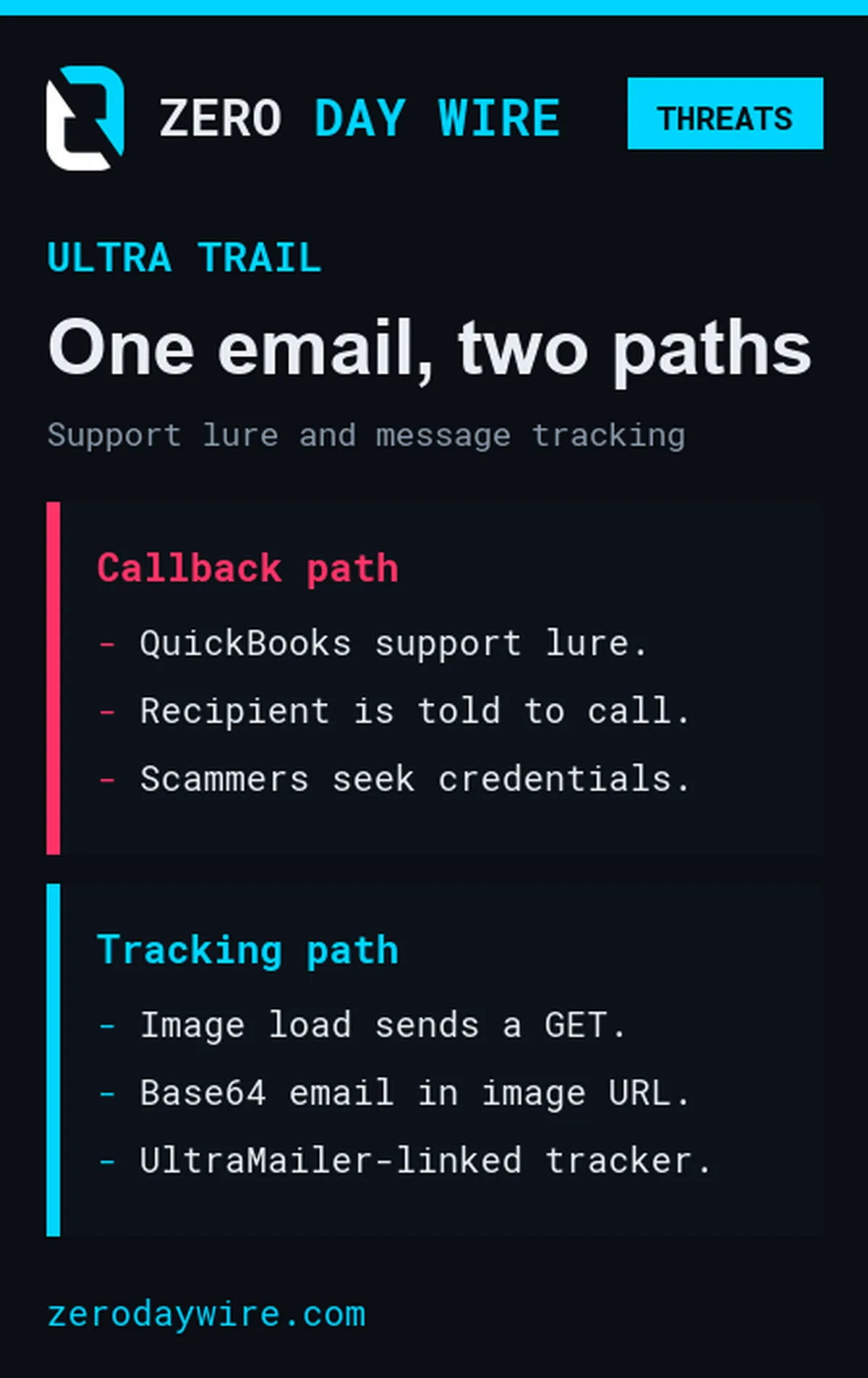
A QuickBooks phishing campaign resumed after an abuse report briefly stopped it, according to research published by Infoblox on 29 October. The operation uses more than 350 lookalike domains and asks recipients to telephone supposed support staff, who then try to steal their QuickBooks credentials.
The useful detail is how it came back. Infoblox traced the emails through tracking infrastructure associated with the bulk-mailing application UltraMailer. When the operator switched to another provider, Mail250, an abuse report led to an account suspension and the observed campaign stopped. On 8 September, the operator returned to the earlier tracker and resumed sending.
That makes this more than another warning about a convincing support message. It shows a callback scam surviving a provider's intervention by returning to infrastructure it had used before. For defenders, the support call, the remote-access tool and the software installer each need their own trust check.
The phone call is the trap
Infoblox describes emails impersonating QuickBooks support, backed by more than 350 lookalike domains. Most were registered with Dynadot between 29 June and 5 July 2026. That is a count of domains, not compromised accounts or confirmed victims.
The messages tell recipients to call a supposedly toll-free number. The numbers the researchers observed instead used the 805 area code. On the call, scammers attempt to obtain QuickBooks credentials. The report does not provide a total for successful thefts.
There is also a quieter signal in the message. If remote images load, an embedded tracking pixel contacts a domain associated with UltraMailer's tracking service when the email is opened. Its URL contains a campaign directory and the recipient's email address encoded in base64. Encoding changes how the address looks; it does not make the address confidential.
Infoblox believes the directory corresponds to a customer or sending batch. That interpretation is less certain than the visible address encoding and should not be treated as an established account identifier. Nor does use of the tracking service mean its developer sent the phishing emails.
One suspension, then a return
In August, the operator moved away from the UltraMailer-associated tracker. A tracking subdomain beneath a QuickBooks lookalike instead pointed to infrastructure Infoblox attributed to Mail250.
The researchers reported the activity to Mail250 on 25 August. The provider said it suspended the user, and Infoblox verified that the observed campaign stopped. The report describes a prompt response, but does not give an exact suspension time or say that every related message disappeared.
On 8 September, the same tracked campaign returned to the earlier service. Infoblox says it continues. That is the researchers' assessment as of their report, rather than a separate claim that Zero Day Wire has tested the infrastructure today.
Infoblox found no abuse-reporting mechanism on UltraMailer's website. That difference matters when choosing a business service: defenders need a working route to report harmful use, as well as controls inside their own mail environment. An account suspension can interrupt a campaign without removing the operator's other routes.
A genuine app inside a bad installer
The wider investigation began with a different scam. During earlier research into Help TDS, a fake Microsoft support agent told Infoblox to install UltraViewer, a legitimate remote-access application. Domain-registration links then led the researchers to UltraMailer and its tracking service.
The report also documents malicious installers containing authentic copies of both applications. These findings should not be collapsed into one infection chain. Infoblox does not establish that the QuickBooks phishing operator distributed those installers, or that a callback in this campaign necessarily led to UltraViewer.
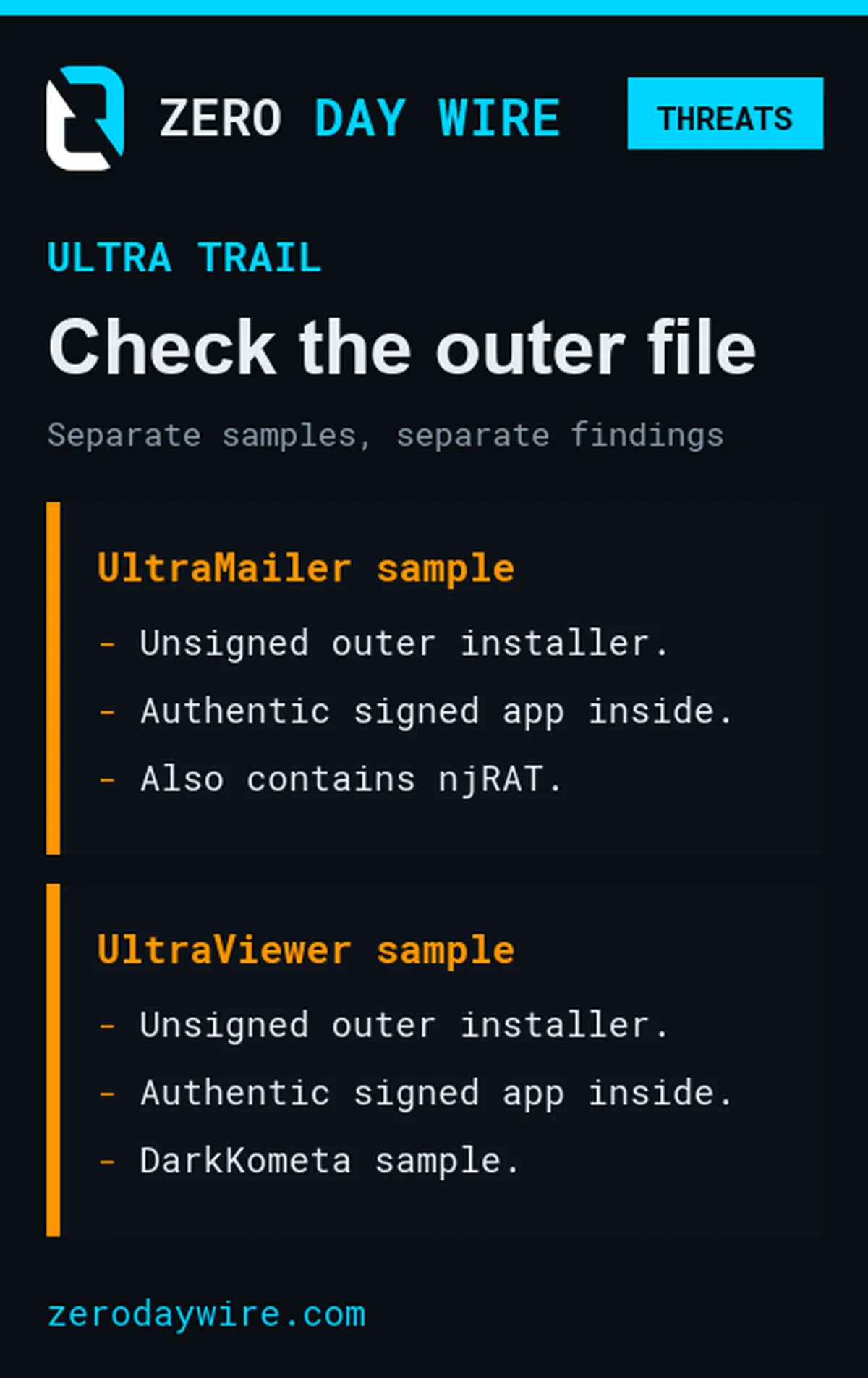
One unsigned UltraMailer installer contained an njRAT payload alongside a genuine, signed copy of the mailing application. A separate unsigned UltraViewer installer contained a signed authentic application and was identified as Win32.Comet.A, also known as DarkKometa. That sample installed itself under a Synaptics-themed path, impersonating a touchpad driver.
The signature distinction is the practical lesson. A valid signature on a bundled application tells you about that component. It does not establish that the enclosing installer is safe, or explain the other files it delivers.
Infoblox found no evidence that either application's developers participated in the scams or distributed this malware. It also could not independently corroborate a separate research firm's claim that a related signing key had been stolen. Neither point should be turned into an allegation against the developers.
Trust the whole package
For accounts staff and QuickBooks administrators, the first change is procedural. Verify an unexpected support message through a known contact route. A familiar product name, a plausible telephone number and a message that survives email filtering are not enough to authorise a credential handover or remote session.
Security teams should also decide which remote-access applications belong in their environment. Infoblox recommends considering restrictions on UltraViewer where there is no business need. Where a support tool is approved, an unsolicited caller still needs verification before anyone grants control.
For software deployment, inspect the downloaded package and its origin, not just the signature of the application found inside it. During an investigation, correlate the installer, extracted files and subsequent behaviour. Finding a familiar signed executable is the start of that review, not its conclusion.
The campaign's return is a reminder to retain the earlier email and tracking patterns after an effective abuse report. The provider may close one account. The operator can still have somewhere else to send from.