Northflank's secret exposure reaches beyond its own platform
Northflank says customers should assume their environment variables were decrypted. Revoke provider credentials, replace workload secrets and review AI usage after reports of key abuse.

Northflank customers need to revoke and replace the credentials they stored on the platform, including credentials for services outside it. The cloud hosting company has told all users to assume their environment variables have been decrypted, and says customers have reported unauthorised use of AI API keys supplied to its platform.
Its public incident notice, opened on 30 October, calls for immediate rotation across workloads, secret groups and global secrets. Over the weekend, Northflank expanded rotation support for database and other add-ons. It also enabled audit logs for every customer, including free users.
Those are useful recovery measures. They leave customers with a separate job: invalidating the access a copied credential could still grant at its original provider, then putting working replacements into the applications that depend on it.
As of 01:31 UTC on 2 November, the incident was still marked Identified. Northflank had not published a confirmed initial access method, a count of affected customers or a complete account of what attackers accessed. Its advice to assume broad exposure is a containment instruction. It does not establish that every stored secret was stolen or used.
The warning covers more than AI
The reported AI-key abuse is the clearest stated customer impact. Northflank's response instructions reach further: all secrets and credentials stored in workload configuration, secret groups and global secrets need attention.
Environment variables are a convenient way to give an application access to a database, an external API or a cloud account. A stolen value can therefore open a service that Northflank does not operate. The precise risk depends on what the credential permits, whether it remains valid and what restrictions its issuer applies.
That distinction matters during triage. An AI provider's billing dashboard might show the first obvious sign of misuse, while a database password or another API token needs a different check. Northflank has reported customer accounts of unauthorised AI use. Its public notice does not confirm abuse of every other credential class.
Start with a list of the secrets held in each of the three named storage scopes. Record their issuing service, the workloads using them and the person responsible for replacement. Work from secret names and references rather than copying values into an incident spreadsheet or support conversation.
Rotation tools caught up
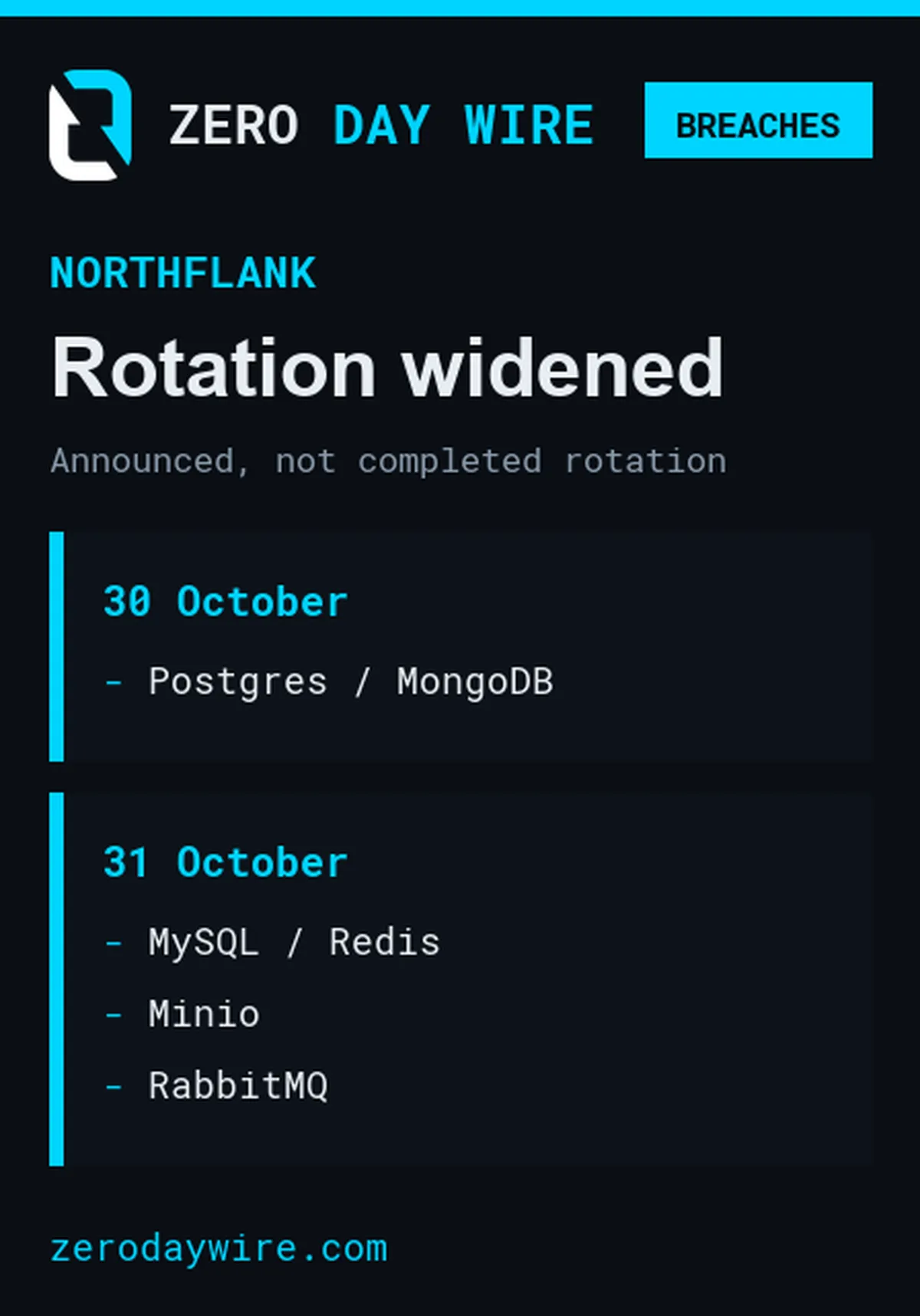
Northflank's updates show recovery support widening after the initial warning. It announced secret rotation for Postgres and MongoDB on 30 October. MySQL and Redis followed on 31 October, then Minio and RabbitMQ later that day.
These are the dates Northflank announced the controls. They do not date the intrusion, identify when any particular credential was exposed or show that customers have finished rotating it.
The company also advises disabling public access to add-ons where it is enabled. Its database documentation explains that databases have internal access by default, with public exposure available for supported configurations. Review what your deployment actually exposes. A private database endpoint and a revoked database password address different parts of the risk.
For teams that paused because an add-on lacked a rotation control, the weekend announcements are a reason to return to that item now. Check each dependency rather than treating one successful password change as completion for the project.
The key still works elsewhere
Northflank gives customers three linked instructions: revoke existing credentials with their issuing providers, generate replacements, and update the affected secrets and workloads in Northflank.
Replacing a stored variable changes the configured value. It does not, by itself, revoke the old credential or prove every running workload has loaded its replacement. If someone copied that value before the change, their copy may remain usable until the issuer invalidates it or another restriction blocks it. For secret groups, Northflank's documentation tells users to restart services or start new job runs to apply updated runtime variables.
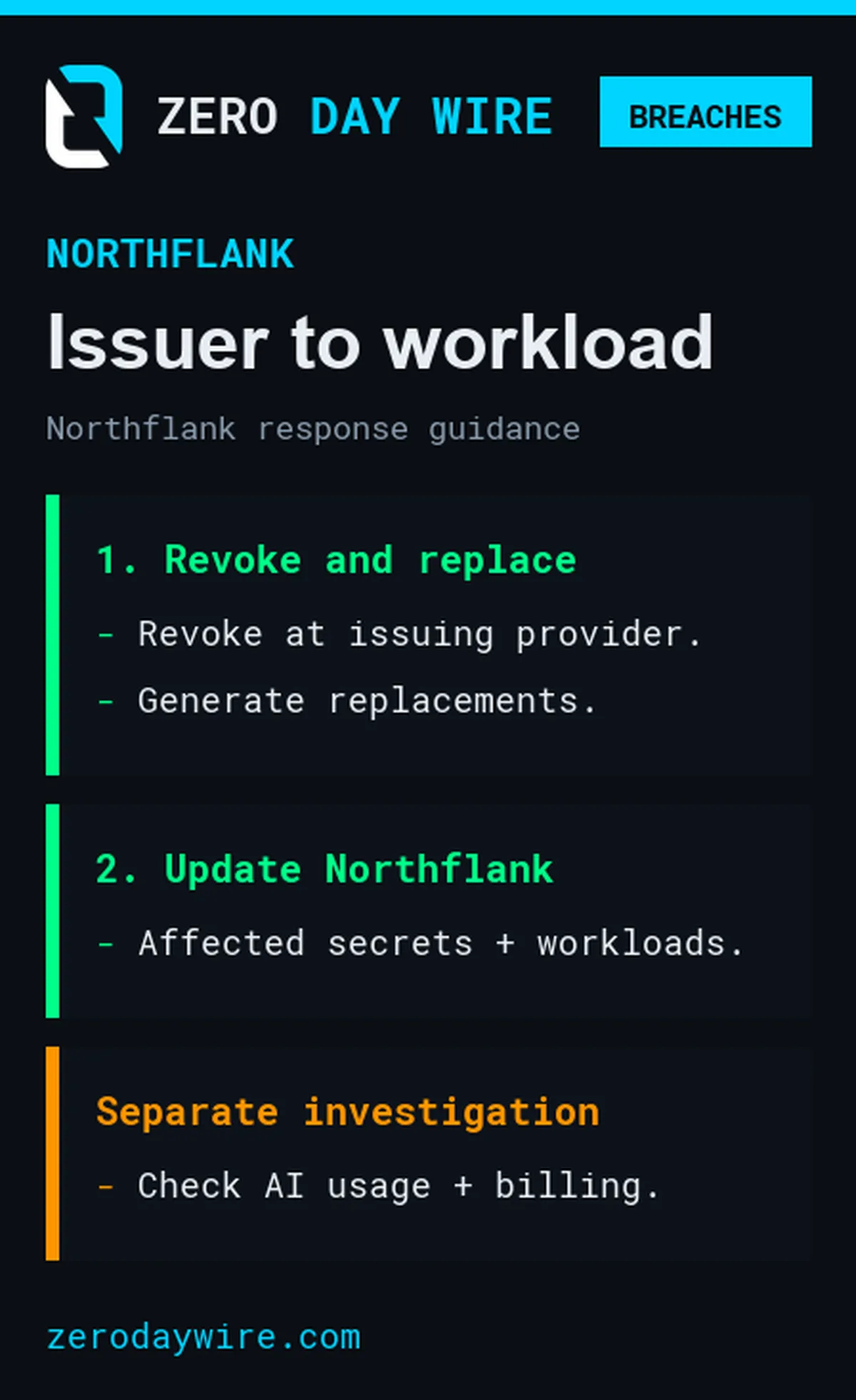
Handle the dependency as a whole. Identify the credential at its source, revoke the old access, create the replacement and update every affected consumer. Verify that the application can still reach the service it needs. For a shared credential, include background workers and scheduled jobs in that check, not just the public web application.
There may be a service interruption while credentials change. Plan and track the work, but do not leave an old key active simply because a new value appears in the dashboard. The meaningful completion check is that the issuer rejects the old credential and the intended workload uses its replacement.
Use the logs now available
Northflank says audit logs are now enabled for all customers, including those on free plans. Use them alongside the affected providers' own records. The incident notice specifically recommends reviewing AI-provider usage and billing logs for unexpected activity and reporting suspicious use to Northflank support and the relevant provider.
Look for activity that the application owner cannot explain, including unexpected usage or charges. Preserve the relevant records before retention limits remove them. Audit-log availability alone does not establish that a record exists for every action during the incident, and the notice does not promise a complete historical reconstruction.
Northflank also points to Wiz's research into attacks on AI development platforms. That broader reporting is context. It does not establish a shared initial access method or a single actor behind every incident, and Wiz's unnamed downstream abuse cases should not be treated as Northflank customer cases.
Revoke beyond Northflank
The immediate task is concrete: account for the secrets held in Northflank, invalidate the old access at the appropriate provider, replace the values in affected workloads and investigate possible misuse. Include the add-ons whose rotation controls arrived over the weekend.
Keep unresolved items visible. A credential with an unknown owner, an unreviewed external service or a worker still using an old value is unfinished response work. The absence of an unexpected AI bill does not close those gaps.
Northflank's platform fixes and customers' credential recovery meet at the same boundary. The hosting service can change its controls; only the service accepting a copied credential can stop accepting it.