Rebooting Node-RED can leave the backdoor behind
Node-RED attacks attempt to deploy persistent command-running flows. Check embedded gateways, remove malicious routes and verify editor and HTTP-node security separately.


Rebooting a Node-RED host can clear a payload from a memory-backed directory and still leave the attacker a way back in. New research describes malicious flows that expose a command-running HTTP endpoint, rather than simply downloading a bot. The flow itself becomes the backdoor.
VulnCheck's report, published on 2 November, records 16 attempts against its Node-RED canaries from one source address between 30 October and 1 November. Some delivered downloaders. Others attempted to deploy flows designed to accept commands later. That makes reviewing the deployed flows part of containment, alongside restricting access and updating affected devices.
There is an important limit here. These were canary observations, not a report of confirmed compromises at industrial operators. The canary returned the response expected from a vulnerable deployment. VulnCheck did not retrieve the binaries or staged scripts, so their final capabilities remain unknown.
The flow does the work
Node-RED lets users connect small pieces of application logic in a browser. That includes components which execute operating-system commands. Giving an unauthenticated visitor permission to deploy flows therefore gives them more than access to a dashboard.
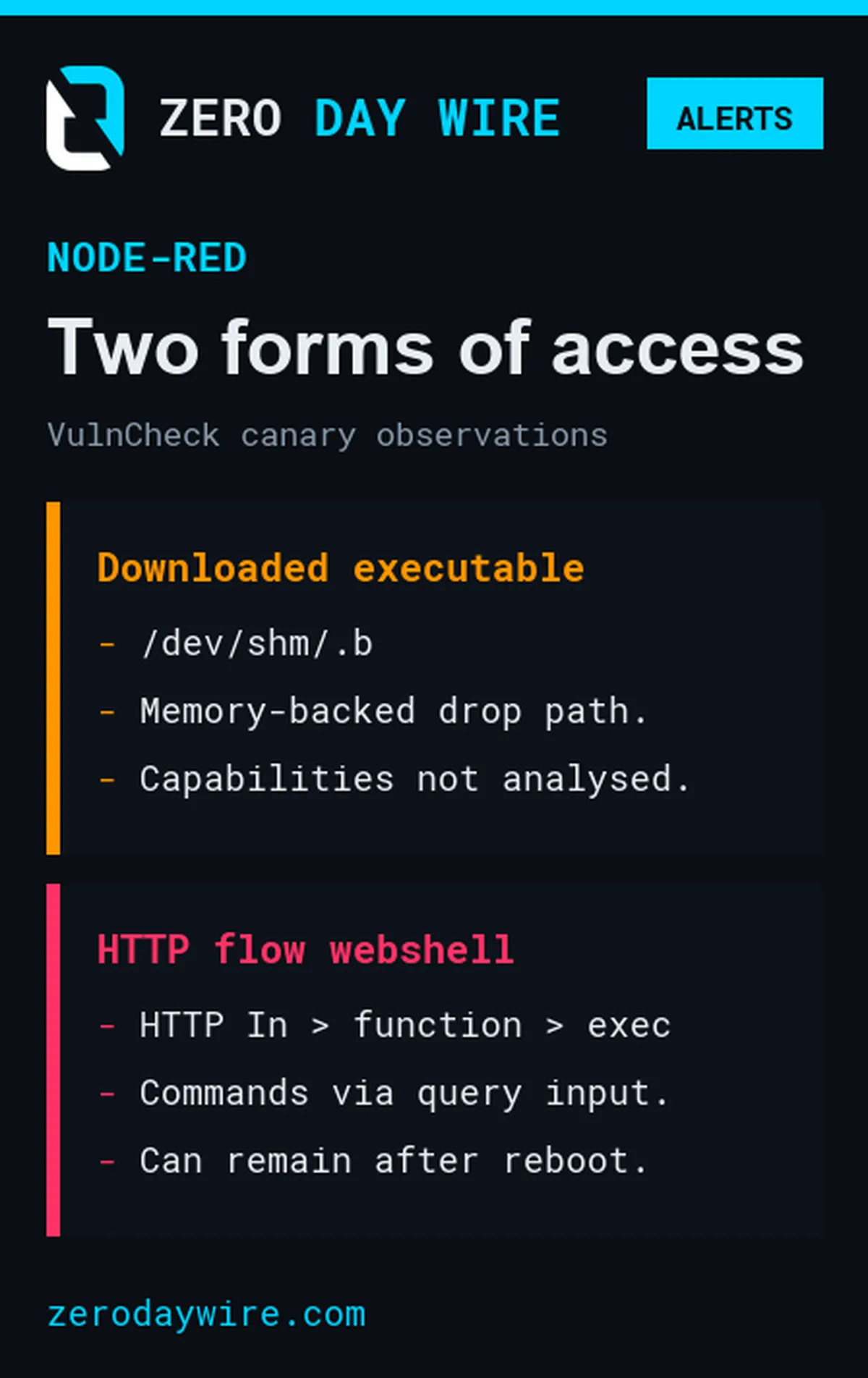
The first captured request combined an automatic trigger with a command-execution node. Its downloader used an encoded shell command and attempted to save a Linux executable to /dev/shm/.b, a memory-backed location. A later variant used /tmp/.kworker, a filename that resembles a kernel worker.
The more consequential variant did not need a downloader. VulnCheck describes an http in node connected through a function node to an exec node. Commands supplied through a query parameter could then reach the shell. The researchers say that flow-based webshell can remain available after a memory-backed implant has been lost on reboot.
An unexpected exec node deserves investigation, but it is not proof of compromise on its own. Running commands is legitimate Node-RED functionality. Compare the full flow, its ownership and its exposed routes with the configuration your engineers intended to deploy.
Keep the Siemens scope precise
The vulnerability identifier attached to the activity is CVE-2026-58115. Its Siemens advisory, originally published on 11 August, names a specific affected configuration: SIMATIC IoT2050 Advanced, product code 6ES7647-0BA00-1YA2, running Industrial OS with Node-RED installed, in versions below V4.3.4.1.
Siemens rates it 10.0 and recommends updating to V4.3.4.1 or later. Its other stated mitigations are uninstalling Node-RED or hardening the installation. CISA republished that product advisory on 25 August.
That is not a claim that every Node-RED installation needs a Siemens product update. The wider exposure question is whether an instance permits unauthenticated flow deployment. Node-RED's own documentation says its editor is unsecured by default and that this is suitable only on a trusted network. Check embedded gateways and automation appliances as well as separately managed application servers.
One authentication setting is not everything
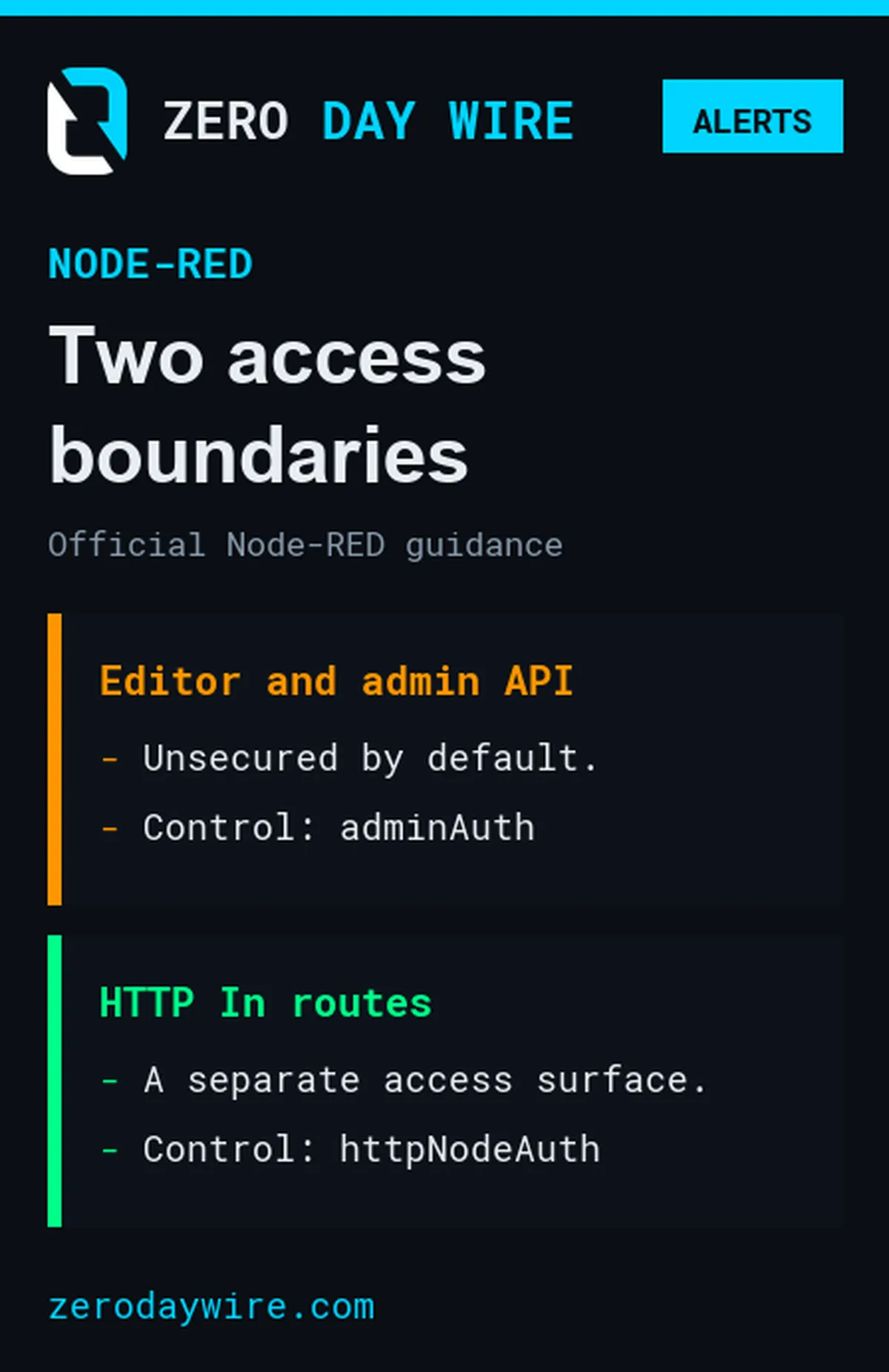
The official security guide separates the editor and admin API from routes created by HTTP nodes. adminAuth protects the editor and admin API. httpNodeAuth provides authentication for HTTP In routes.
The containment implication is straightforward: enabling editor authentication does not, by itself, remove a malicious route already deployed as a flow. Review and remove that flow, and check how the application's HTTP routes are protected. Transport encryption is another separate control. An HTTPS address does not establish that either surface requires authentication.
Action Items
- Restrict access first. Remove unnecessary external reachability to Node-RED's editor and admin API. For operational technology, coordinate changes with the people responsible for safe plant operation.
- Check the exact product configuration. On affected SIMATIC IoT2050 Advanced devices, apply Siemens'
V4.3.4.1or later remediation. Harden or uninstall Node-RED where appropriate. - Review deployed flows before declaring recovery. Investigate unexpected HTTP endpoints, command-execution nodes and downloader behaviour. Preserve relevant configuration and logs before removing confirmed malicious content.
- Verify both authentication boundaries. Check editor/admin access and HTTP In routes separately against the intended configuration. Test from an untrusted network position without deploying a flow.
- Investigate beyond the reboot. Review process and network evidence around suspicious flows. A cleared temporary file is not evidence that the host or its saved configuration is clean.
The immediate task is to close unauthorised deployment and remove any command route it left behind. A reboot alone does neither.