NetamLoader: The Signed File Is Not the Whole Update
NetamLoader hides an execution chain in configuration and resource files beside signed software. The case shows why update reviews must follow the inputs, not just the executable.


A configuration file in a Windows update cache led researchers to a malware chain built around familiar, legitimate software. The executable looked ordinary. So did the Microsoft-signed components it loaded. The dangerous instructions were in the files those components were persuaded to read.
In research published on 29 October, Kaspersky's GReAT team describes NetamLoader, a framework targeting a customised Windows build associated with government use in Asia. Its telemetry identified one victim. The broader government-targeting assessment is an inference from the operating system the malware was designed for, not a published list of compromised agencies.
The sample surfaced in the first half of 2026. Today's news is the technical disclosure, not evidence that an intrusion began today. Its practical lesson reaches beyond that particular Windows build: checking an executable's signature does not establish that everything it reads, loads or interprets is trustworthy.
The package that looked familiar
The investigation started with a CAB archive in the Windows update download directory. Most of its executables were legitimate components of the patch-management tool Patch My PC. The .NET assemblies used in the initial loading chain were Microsoft-signed.
Those details made a first inspection look reassuring. The researchers say the chain became apparent only after they revisited the configuration file and followed the complete loading process.
There is an important limit here. Kaspersky did not observe how the CAB reached the victim. The team says the evidence strongly indicates a supply-chain attack, but the delivery route remains unresolved. Finding the archive in an update directory does not establish that Windows Update delivered it, or that Microsoft, Patch My PC or either company's distribution infrastructure was compromised.
That distinction matters operationally. The report supplies a specific malicious chain to investigate. It does not justify treating every installation of the legitimate patch-management software as an incident.
When configuration becomes execution
The host process loads its accompanying configuration before its main function runs. NetamLoader uses AppDomainManager injection to make that configuration select a Microsoft-signed assembly and a configuration-handling class. A second configuration file then directs the class to a resource file.
That resource file contains a serialised object. Processing it reaches BinaryFormatter deserialisation and then a XAML parser. XAML is familiar as the markup used to describe .NET interfaces, but the loading chain uses it to express executable behaviour. Layers of encoded and encrypted content carry the next stages.
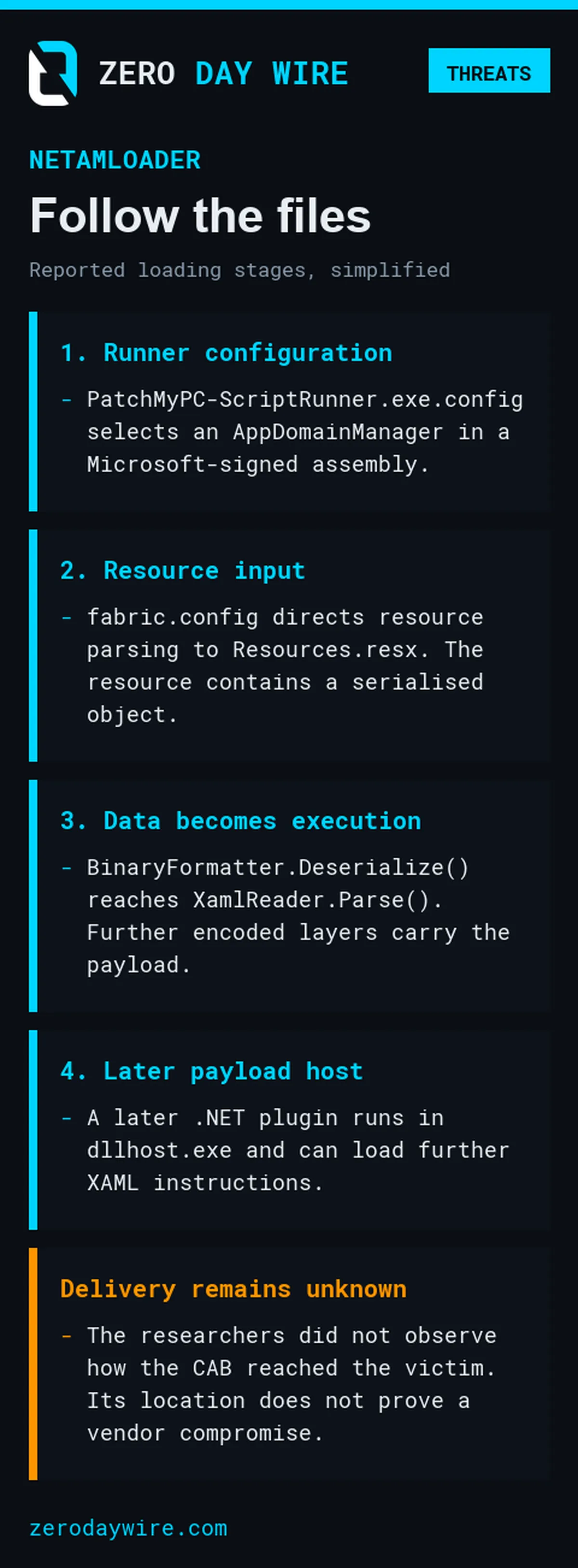
This is why a signed-file verdict is too small a unit of analysis. The signature on a legitimate assembly does not approve an adjacent configuration file or the objects deserialised from a separate resource.
Microsoft's BinaryFormatter guidance makes the underlying risk explicit: untrusted input can influence control flow and lead to code execution in the consuming process. Its warning applies to all .NET Framework versions. Although the built-in implementation throws on use from .NET 9, that does not establish protection for a separate application using the older .NET Framework.
A short observation can miss the next stage
Later stages interfere with the Antimalware Scan Interface and move a .NET payload into dllhost.exe, a legitimate Windows host process. The framework can then retrieve and execute further XAML instructions. Kaspersky also describes attempts to remove files, update-related log entries and execution traces.
The timing is worth attention. The analysed configuration introduces a 20-40 minute delay before the initial command-server request. After a valid response, polling pauses for 5-6 minutes; an invalid response produces a much longer wait. Those are properties of the analysed sample, not a universal schedule for every deployment.
For an investigator, a brief run with no immediate network activity would leave part of that behaviour unseen. Similarly, a clean-looking executable and a familiar process name do not answer which configuration was loaded or what happened inside the process.
The report lists openaigpt4v[.]com as command infrastructure. The name alone does not establish any relationship with OpenAI or use of an AI model. Its reported Cloudflare-hosted address is also insufficient grounds to block shared Cloudflare infrastructure indiscriminately.
Follow the inputs
Start with the reported artefacts and their context. Look for the combination of the runner, its unexpected configuration and the resource files in the update-cache path. Match the published hashes where appropriate, while treating a familiar filename on its own as a lead rather than a verdict.
Where telemetry is available, connect those files to assembly loading, the host process, subsequent dllhost.exe activity and outbound connections. Preserve the package and relevant endpoint records before routine cleanup removes the evidence. These are investigation leads drawn from the research, not a ZDW-tested detection rule.
For people responsible for deployment tooling, the wider question is which inputs a trusted runner is allowed to interpret. Review who can alter the surrounding configuration and resource files, how package contents are validated, and whether monitoring follows the resulting process behaviour. Application teams that still consume BinaryFormatter data should follow Microsoft's migration guidance rather than assuming a configuration switch makes untrusted deserialisation safe.
Kaspersky has not attributed the attack to a known group, and the initial delivery route remains unknown. The finding is still concrete enough to change a review: follow the inputs alongside the signed executable. That is where this loading chain was hiding.