VMware's low-score logging flaw helped spies hide
CrowdStrike says WARP PANDA used a low-score ESX logging flaw as a zero-day. Verify the right host builds and reconsider what a quiet audit trail can prove.

A VMware ESX flaw rated just 2.7 gave attackers something more useful than its score suggests: a way to perform some administrative operations without leaving the expected log record. CrowdStrike says the China-nexus group WARP PANDA exploited CVE-2026-41709 before a fix existed, including in intrusions involving the US legal sector.
The fresh development is the disclosure of that tradecraft. CrowdStrike's report, published on 28 October, places the observed exploitation as late as early 2026. It does not establish that those intrusions are still running today. CISA added the flaw to its Known Exploited Vulnerabilities catalogue on the same day, citing evidence of active exploitation.
For defenders, the immediate question is whether the hypervisor was patched, and how much confidence to place in its earlier audit trail. A quiet log is less reassuring when an attacker could make certain actions disappear from it at the point of execution.
The attacker already needs access
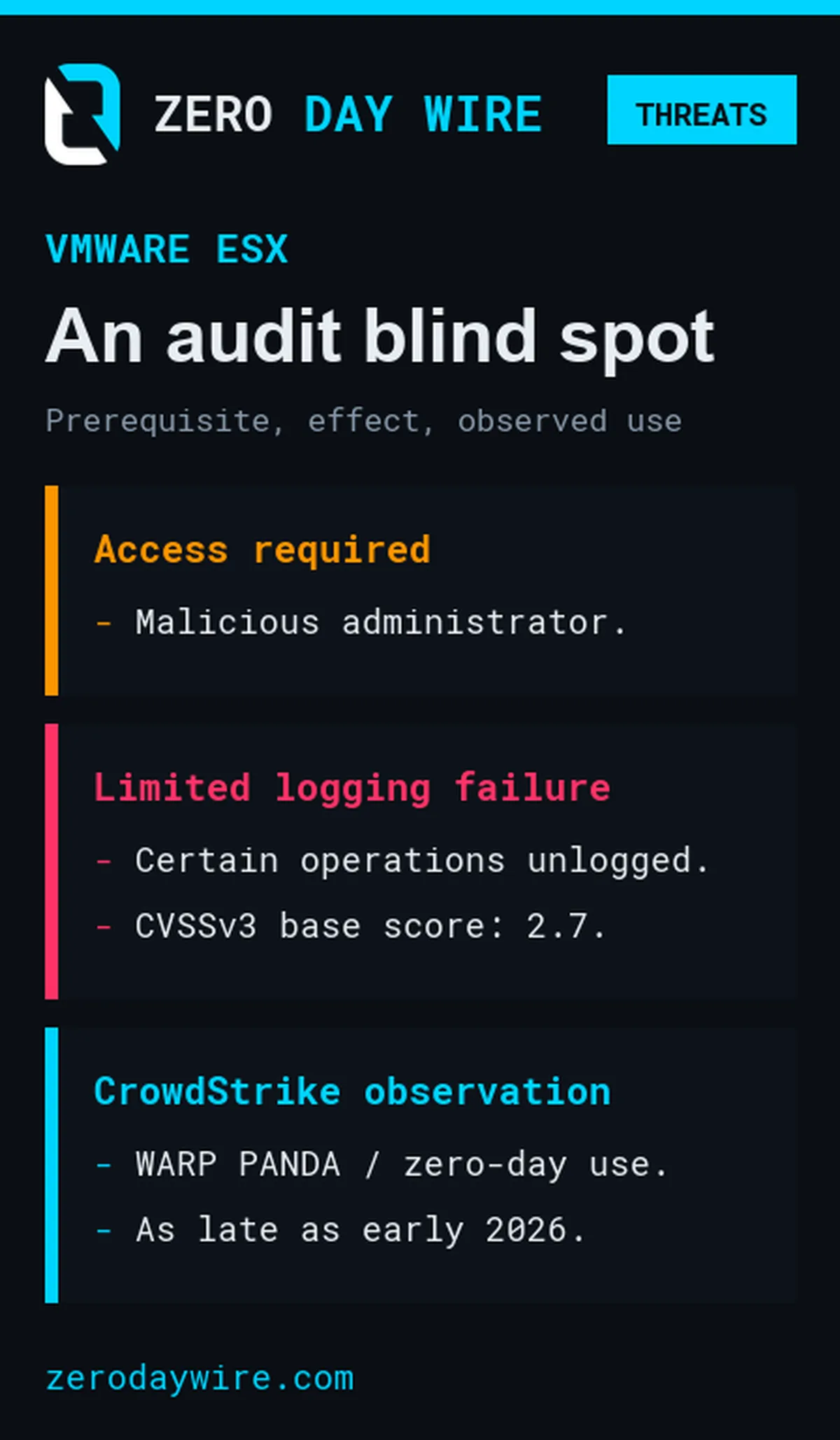
Broadcom's advisory, first issued on 29 July, describes an insufficient logging vulnerability. It requires a malicious administrator. The flaw does not supply an unauthenticated route into the host, and it is not a remote code execution vulnerability.
That prerequisite explains part of the low severity rating. The attacker already holds powerful access; the additional capability concerns what the system records about its use. In an investigation, however, that is a consequential boundary. Administrative access is precisely the activity a responder may need to reconstruct.
Keep the vendor's wording in view: certain operations can go unlogged. It does not say that every action becomes invisible, that all monitoring fails or that previously stored logs are erased. The public advisory does not name the affected operations. Broadcom lists no workaround.
What the report establishes
CrowdStrike describes multiple WARP PANDA intrusions at US-based entities, with legal organisations among the targets. It says the group deployed malware in victims' VMware vCenter environments and used the ESXi command logging bypass as a zero-day in several cases.
Those statements have limits. The public account does not identify the victims, say every affected organisation was a law firm, or provide a case-by-case chain showing how administrative access was first obtained. The malware deployment and logging bypass belong to the same reported campaign activity; the brief account does not establish one identical sequence for every victim.
The dates also describe different things. Early 2026 is the latest period of exploitation stated in the CrowdStrike passage. July is the vendor's disclosure and patch date. October is the new public reporting and KEV addition. Treating October as the start of the attacks would move the evidence by months.
Match the host to the patch
Use the response matrix specifically for CVE-2026-41709 in section 3e of the Broadcom advisory. The page covers several other vulnerabilities with different fixes, so a patch number taken from the next section can be misleading.
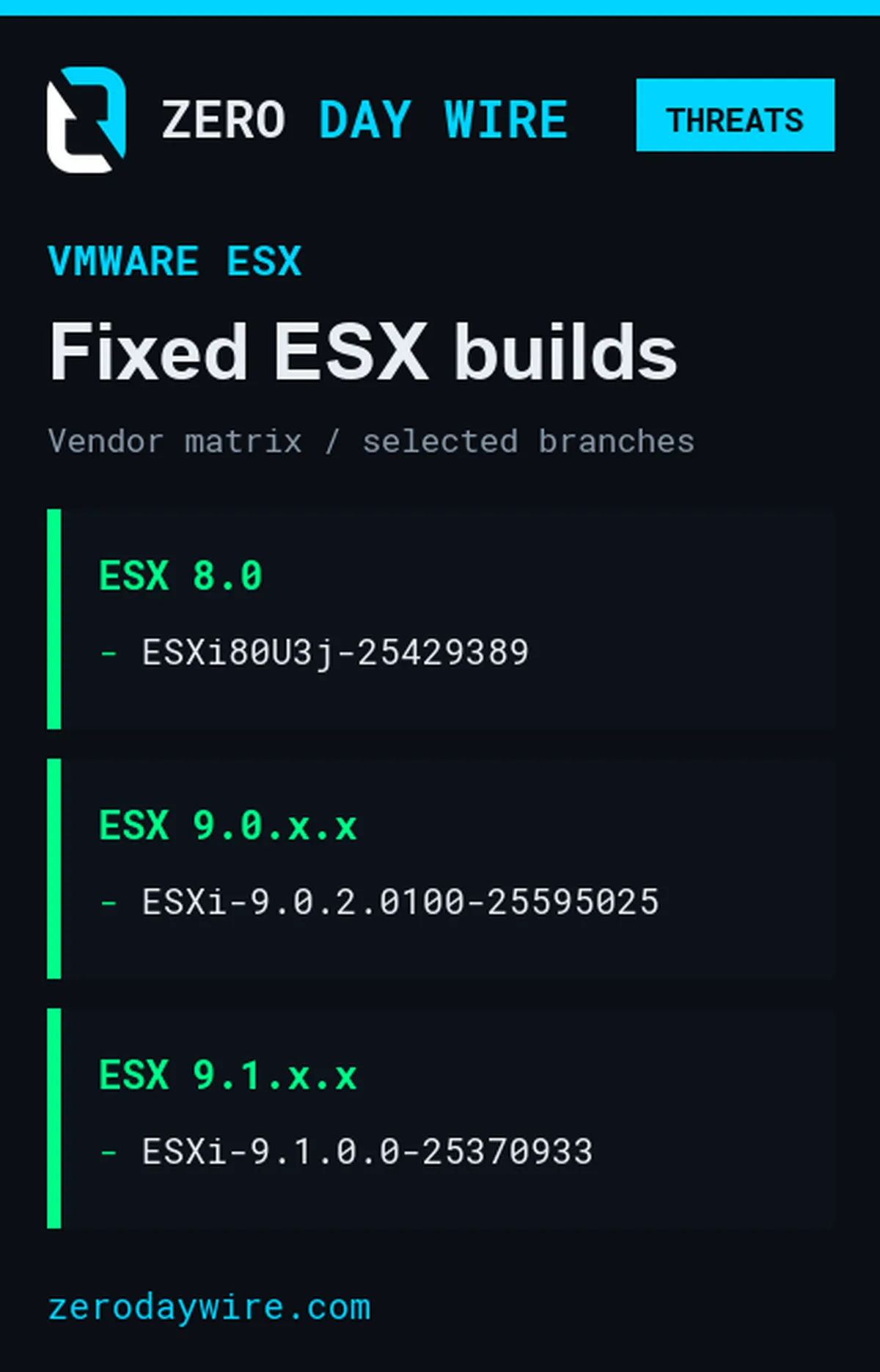
For the main ESX branches, the matrix lists these fixed builds:
- VMware ESX 8.0:
ESXi80U3j-25429389. - ESX 9.0.x.x in VMware Cloud Foundation or VMware vSphere Foundation:
ESXi-9.0.2.0100-25595025. - ESX 9.1.x.x in those products:
ESXi-9.1.0.0-25370933.
The same matrix lists VMware Cloud Foundation 5.x as fixed in 5.2.4. For VMware Telco Cloud Platform 5.0.x and 5.1.x, it points to KB449886. These are the advisory's listed fixes, rather than a claim that each is the newest release available today. Use the supported update path for the product actually deployed.
Check the running build on each host against the appropriate product entry. A completed change ticket or an updated management server is not, by itself, proof that every hypervisor now runs a fixed build. Record exceptions and their owners until the inventory and the deployed state agree.
Investigate beyond the quiet log
Where there is reason to suspect unauthorised administration, preserve the records that remain before routine retention removes them. Compare the hypervisor account with independently retained authentication, management-plane and network records where those are available. Look for activity that needs explaining, rather than treating a missing command entry as evidence that no command ran.
That is investigation guidance drawn from the logging limitation, not a claim that the public report supplies a complete detection method. It publishes no universal query that can clear a host, and this flaw alone does not establish that an unpatched system was compromised.
Patching and retrospective investigation answer separate questions. The update addresses the vulnerability. It cannot manufacture an audit entry for an earlier operation that was never logged. If the surviving evidence cannot resolve an important period, keep that uncertainty in the incident assessment instead of converting it into a clean result.
Patch the blind spot
The useful response is to verify the ESX fixes and reconsider any investigation that relied heavily on a vulnerable host's silence. Prioritise systems with suspicious administrative access or other evidence of intrusion, and retain the distinction between a missing record and a confirmed malicious action.
CVE-2026-41709 shows why an exploitation record can change the significance of a low severity score. The attacker did not need this flaw to become an administrator. Its value was in making some of what happened next harder to establish.