Patching Drupal Commerce leaves another job: audit the orders
Drupal Commerce's exploited access bypass needs more than an update. Maintainers tell merchants to audit orders, verify payment evidence and patch related modules.

Updating Drupal Commerce closes a route into the shop. It does not establish whether an earlier order was genuine. The maintainers are asking merchants to audit recent orders as well as install the fixes for an access-control flaw they say is being exploited.
The Drupal Security Team disclosed CVE-2026-118539 on 28 October. It rates the Commerce Core issue Highly critical, at 21 out of 25 on Drupal's own risk scale. That is not a CVSS score.
Centarro's follow-up, published on 29 October, explains the practical concern. The Drupal Commerce maintainers received two reports of attempted fraudulent orders from merchants who saw suspicious activity on live sites. At that writing, Centarro said it did not believe the issue had been scripted or exploited beyond those initial sites. Neither account establishes a total financial loss or shows that every vulnerable shop has fraudulent orders.
A paid label needs supporting records
The advisory says Commerce Core fails to protect certain routes and entity fields sufficiently, creating an access bypass that may financially affect the merchant. Centarro says both full-stack and headless shops are affected, although their attack paths differ.
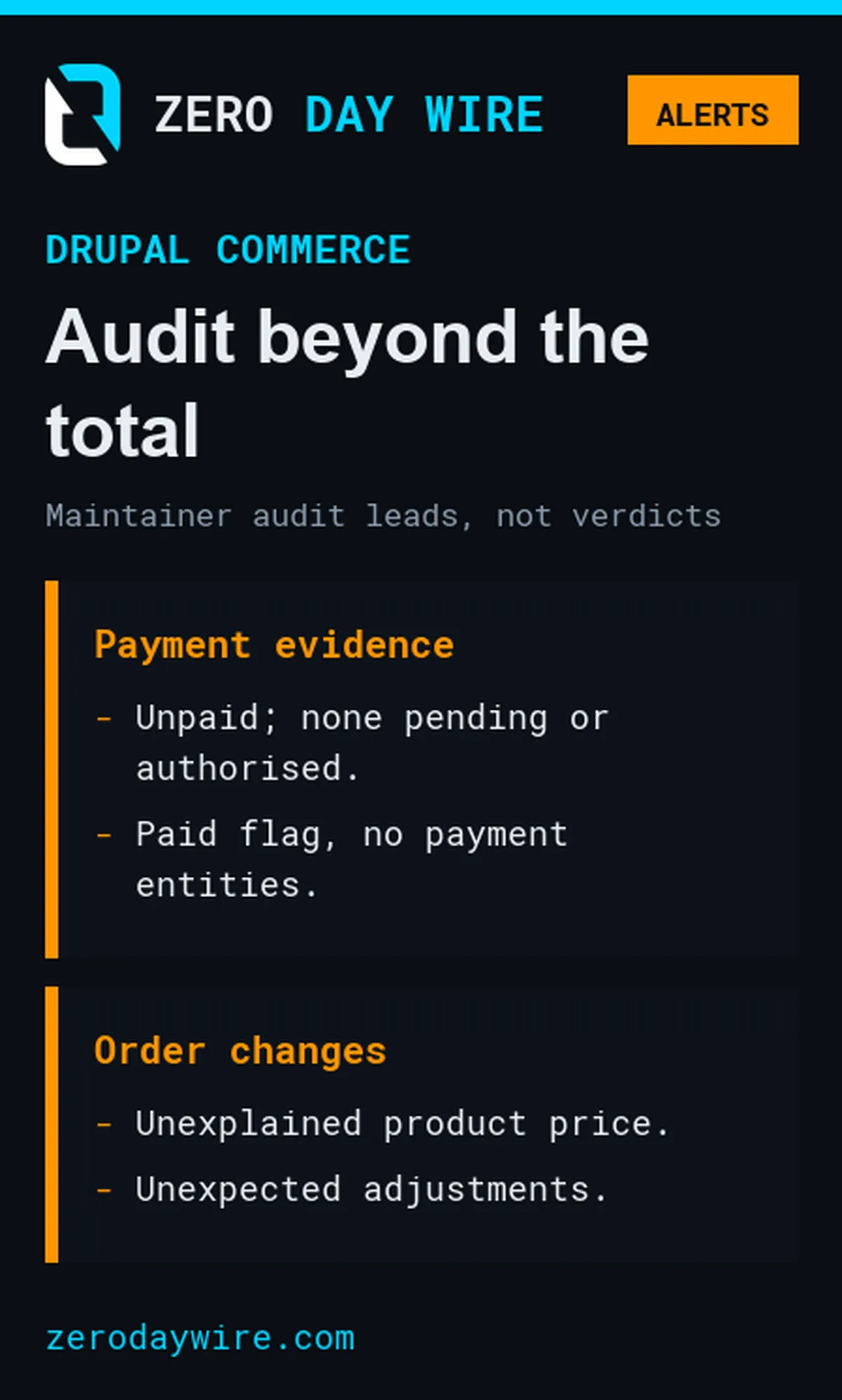
Its audit rubric goes beyond looking for unusually cheap purchases. Check orders that were placed without payment and have no pending or authorised payment. Also check orders that appear paid in the order-management system but have no associated payment entities. Centarro says the latter check is primarily relevant to shops that permit Commerce data updates through Drupal's JSON:API module.
Then review product prices and adjustments. A price override that your staff did not make, or a discount or fee with no legitimate promotion or staff action behind it, deserves investigation.
Centarro says the reports included both obviously incorrect prices, such as $0.01, and normal prices. A plausible total therefore cannot clear an order by itself. The useful question is whether the order's contents, payment evidence and route through the shop agree.
A match is an audit lead
These checks are not a list of confirmed fraudulent transactions. Centarro explicitly warns that legitimate orders can match: staff-created orders, custom checkout paths, authorised payments, donations and deliberate price overrides all need context.
Its published SQL queries are starting points, not a complete incident test. One payment-total check can miss an order if a later payment has already caused its recorded total to be recalculated. A clean result from that query cannot prove that no earlier manipulation occurred.
Review suspicious records against the store's legitimate behaviour, payment records and available access logs. Keep customer data inside the organisation's incident process. The disclosure date is not a documented start date for the attacks, so choose the audit period from the site's exposure and retained evidence rather than assuming that anything before 28 October is safe.
Update the Commerce modules too
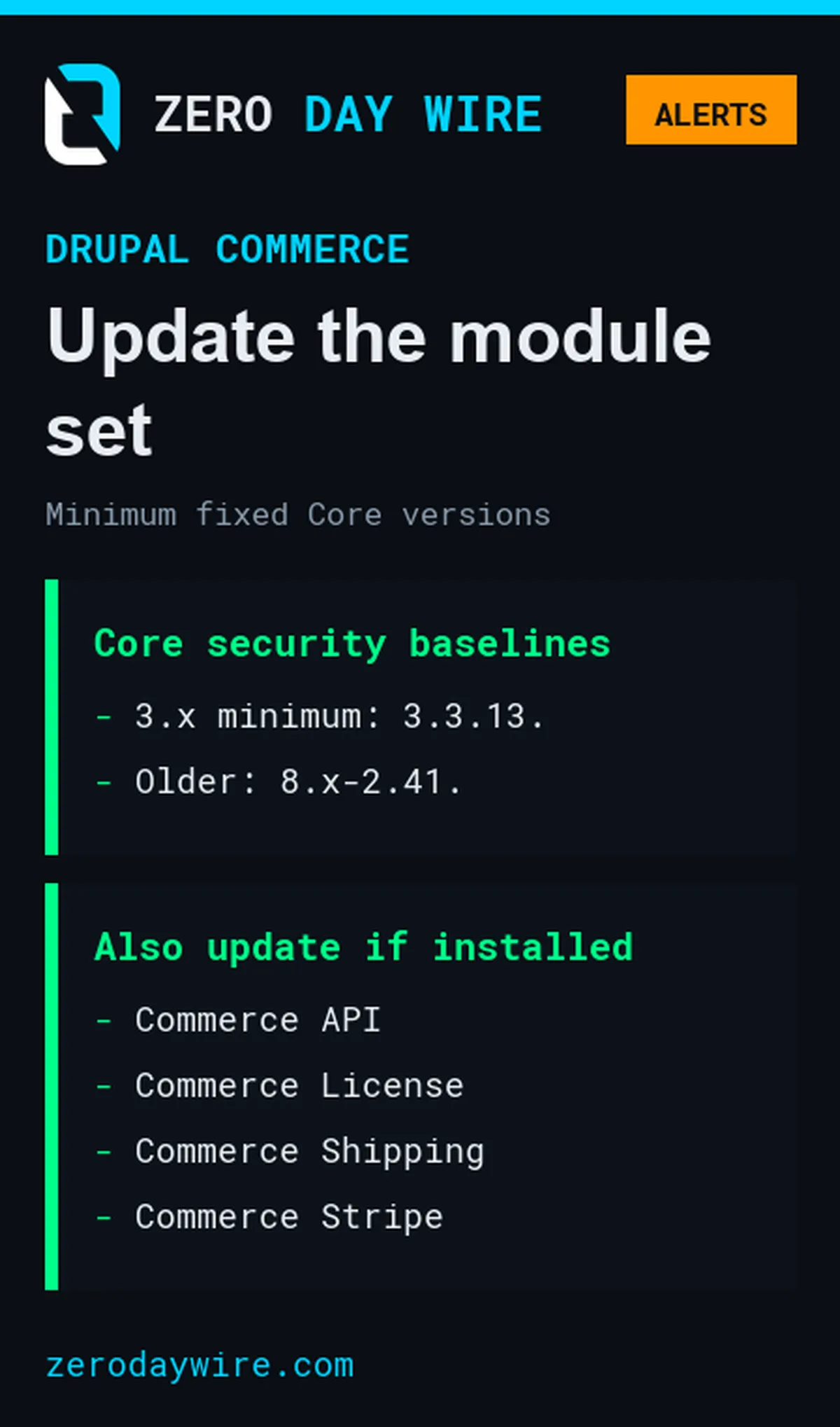
The minimum fixed Commerce Core releases in the security advisory are 3.3.13 for the 3.x branch and 8.x-2.41 for earlier supported deployments. These are security baselines: Commerce Core 3.3.14 followed on 3 November. Check the current supported release for the branch you run.
Centarro also says to update Commerce API, Commerce License, Commerce Shipping and Commerce Stripe at the same time where they are installed. Those are related security updates; this does not establish that every companion-module flaw is part of the observed exploitation.
For shops that do not need JSON:API update operations, Centarro recommends returning that interface to read-only while still updating promptly. Treat that as a reduction in exposure, rather than a substitute for installing the fix. A headless storefront is not exempt from the Core advisory.
Action Items
- Patch the correct package. Check Commerce Core's installed branch and apply a supported release containing the fix. Updating Drupal core alone is a different task.
- Check the companion set. Review installed Commerce API, Commerce License, Commerce Shipping and Commerce Stripe modules against their security releases.
- Audit payment evidence. Investigate placed-but-unpaid orders, paid flags without supporting payments, unexplained prices and unexpected adjustments.
- Confirm before fulfilment. Centarro advises checking order details, including full payment, before delivering goods or services. Checkout completion alone is not that confirmation.
- Preserve and investigate anomalies. Account for legitimate custom behaviour, correlate available records and use the confidential Drupal security-reporting process for a suspected vulnerability.
The patch and the order audit answer different questions. Finish both before treating the response as closed.