Old Patches, Fresh Intrusions: Plex2Shell, PHP2Shell and the Week's Exploited Flaws
Plex2Shell, PHP2Shell, appliance implants and ransomware access lead this week's briefing, with verified patch guidance and a separate watchlist for conditional flaws.


An internet-facing media server becomes a miner and a proxy. A remote-support appliance becomes a tunnel into the network it was meant to help administer. A genuine, signed software installer loads the attacker's DLL. This week's vulnerability news is less about a single spectacular bug than the different ways attackers turn trusted software into access.
For the week ending 23 October, the immediate priorities are PHP runtime updates, exposed Plex servers and a renewed look at remote-access infrastructure. But the details matter: an unauthenticated web exploit, an administrative privilege escalation and a malicious installer are not interchangeable risks.
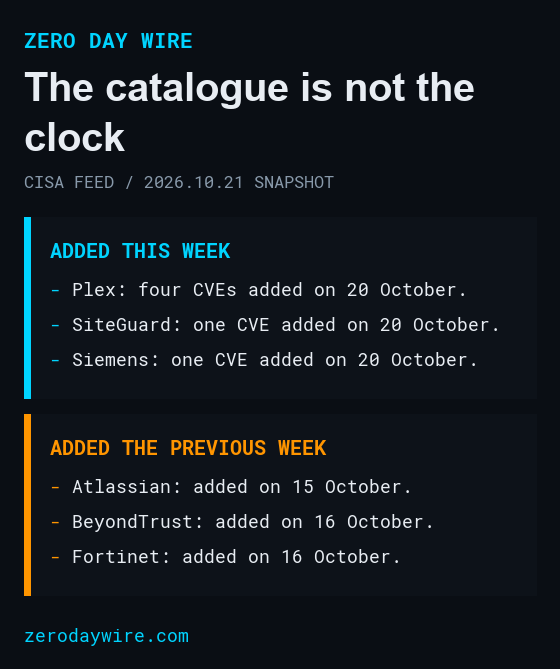
There is a chronology correction, too. CISA's refreshed feed contains seven KEV additions this week: four Plex flaws, SiteGuard and Siemens on 20 October, followed by Arista VeloCloud Orchestrator on 23 October. Atlassian, BeyondTrust and Fortinet were added on 15 or 16 October, the previous week. These are catalogue admission dates, not the dates the vulnerabilities were first exploited. The catalogue checked at 20:08 BST on 23 October identifies itself as version 2026.10.23. CISA KEV feed
The 20 October KEV batch
Plex2Shell: check the build number, not just the version family
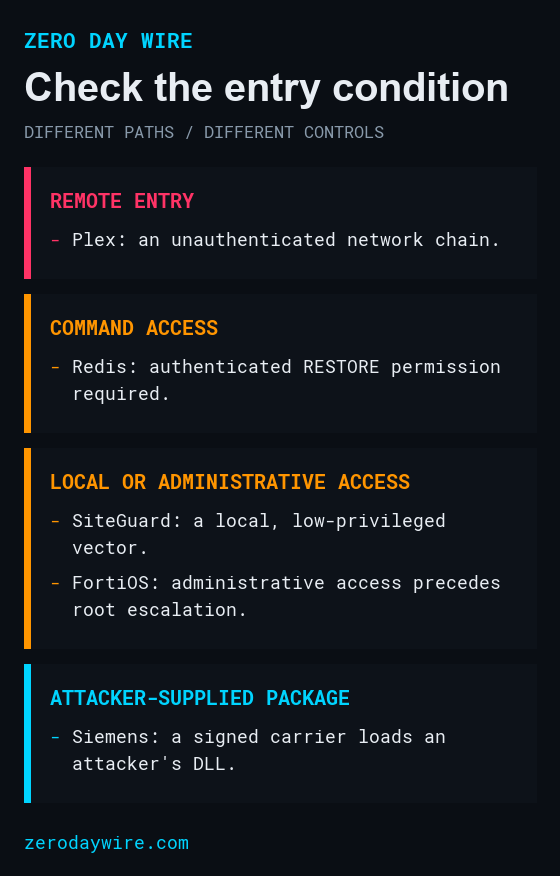
Plex2Shell joins CVE-2026-96652, CVE-2026-96654, CVE-2026-96655 and CVE-2026-96656 into an unauthenticated code-execution chain. The research moves from server-side requests into trusted loopback functionality, obtains the owner's token, then abuses transcoding and codec loading to execute attacker-controlled code. The combined effect matters more than treating the four entries as unrelated patch tickets. Original research
The current researcher repository gives an important build-level warning: 1.43.3.10828 is still vulnerable; 1.43.3.10861 is the fixed build. A dashboard displaying only "1.43.3" is not enough to settle exposure. Plex's own notice recommends updating Media Server and warns that NAS package managers can lag behind the available update. Researcher version correction, Plex update notice
Public technical disclosure was on 16 October. BoredHackerBlog reported exploitation against a deliberately vulnerable honeypot on 17 October, with later collection recovering XMRig and a process named myawesomeproxy. The researcher flags incomplete payload capture because outbound traffic was initially restricted. That supports a dated observation of exploitation and payload delivery, not a worldwide victim count or attribution to every campaign using similar infrastructure. Honeypot report
For exposed systems, update and investigate together. Review unexpected codec files, child processes, miners and proxy activity. Removing a miner alone does not establish that the original access or other persistence has gone.
SiteGuard: preserve the evidence before the update
CVE-2026-106931 affects the statistics functionality in SiteGuard Server Edition. The vendor confirms exploitation and says the feature is enabled by default. Its advisory describes a local, low-privileged attack vector leading to commands with root or SYSTEM privileges; it should not be flattened into another unauthenticated internet RCE.
The particularly useful instruction is operational: the vendor warns that applying the fix can remove attack traces and asks customers to download diagnostic information first. The fixed versions are 8.00 Update5, or 7.00 Update6 for FreeBSD; patches for older releases are also available. Preserve the diagnostic material, contain an affected host as necessary, then follow the appropriate vendor remediation. SiteGuard advisory
Siemens: a signed carrier is not a clean installation
For CVE-2026-110936, Siemens describes a different route. Attackers distributed a genuine signed copy of Siemens Software Center with malicious neighbouring DLLs. Starting the vulnerable executable loaded those files. Siemens attributes the activity to the Romulus ClickFix campaign and says it has no knowledge of a breach of its systems or update channel.
The fix is 4.0.9.8 or later. Existing installations update on their next start, but that does not remove an attacker's separately distributed bundle. Siemens recommends looking for the executable under an unexpected AppData\Local\Programs location, launched by msiexec, and for unfamiliar adjacent DLLs. Detect the surrounding behaviour and installation path, not merely whether the executable's signature is valid. Siemens exploitation account, SSA-580366
Late addition: VeloCloud Orchestrator
CISA added CVE-2026-114625 on 23 October, after the earlier catalogue snapshot used for the figure above. Arista confirms active exploitation of this SQL injection in VeloCloud Orchestrator. It requires a valid portal session, but the lowest built-in role, Enterprise Read Only, is enough to reach operator privileges. Hosted deployments, including Dedicated, have already been patched. On-premises operators should update to 5.2.3.18, 6.1.3.10 or 6.4.2.12, according to their release train, and preserve relevant logs before remediation where feasible if compromise is suspected. Arista advisory
PHP2Shell: the attempt came before disclosure
The most urgent runtime story is CVE-2026-109618 and CVE-2026-109619. PHP's advisories describe memory corruption around out-of-memory handling and stale request state. These are PHP Core problems: updating a CMS or its plugins without replacing the vulnerable runtime does not fix them. PHP security release
The first fixed supported releases, issued on 21 October, are:
- PHP 8.2.35
- PHP 8.3.36
- PHP 8.4.27
- PHP 8.5.12
Amazon Threat Intelligence retrospectively identified a 17 October attempt in its MadPot telemetry, before the public disclosure on 21 October. AWS explicitly leaves open whether the observed attempts would have succeeded against real deployments. It also says it is unclear how the actor obtained the information. This is evidence of pre-disclosure targeting, not proof of a particular leak or of a global first attack. AWS MadPot investigation
PHP's own research establishes successful code execution under specific conditions. The out-of-memory flaw has a complete unauthenticated HTTP exploit against mod_php; the advisory does not report a complete FPM exploit for that same flaw. The stale-state issue has validated mod_php and FPM paths, but depends on request lifecycle, application behaviour and reuse of the same worker. Treat PHP web deployments as an update priority without claiming every installation has the identical exploit path. Out-of-memory advisory, Stale-state advisory
Cloudflare's Matthew Prince reported a rise from thousands of attempts before the public announcement to millions by his 22 October post. Those are approximate, company-reported attempts, not millions of compromised websites. WAF coverage is supplementary: response inspection cannot undo code already executed at the origin. Original volume statement, Cloudflare technical account
Update the runtime in hosts and images, restart or replace workers, and review retained evidence from at least 17 October. Correlate suspicious uploads and fatal or memory errors with unexpected worker child processes, changed files and outbound traffic. One error message is not an intrusion verdict.
A same-day follow-up matters: PHP's 23 October notice recommends keeping session.upload_progress.enabled=0 pending a fix for a separate session-serialisation issue, CVE-2026-115560. The described path requires a php_binary or php_serialize session configuration, a runtime switch to php before session_start(), and upload progress remaining enabled. It does not negate the fixes above. Apply the upload-progress control administratively before request parsing and restart workers; a late application-level change is not equivalent. PHP follow-up notice
Redis: an old fix, with a command-access prerequisite
CVE-2026-25243 affects deserialisation in Redis's RESTORE command and can lead to execution as the Redis service account. The vendor requires authenticated access and permission to run RESTORE. An exposed instance that permits commands without authentication removes an important barrier through configuration; this CVE is not itself an authentication bypass. Redis published fixes on 5 May. Redis vendor advisory
Defused reported repeated scripted attempts against decoys overnight on 16-17 October, including malformed RESTORE input, a Lua computation probe and destructive FLUSHALL commands. That is worth investigating, but the public report does not demonstrate successful native-code execution. A database accepting a destructive command and a memory-corruption exploit succeeding are different findings. Defused observation
The vendor's fixed community releases include 6.2.22, 7.2.14, 7.4.9, 8.2.6, 8.4.3 and 8.6.3. Redis Software has a separate version matrix. Restrict network access, enforce authentication and deny unnecessary RESTORE access through ACLs while completing remediation. The GitHub advisory's incomplete "TBD" patch field should not override the published vendor fixes. Vendor patch matrix, 6.2.22 release
The access that survives a patch
Atlassian: the file read can reach the identity layer
Added to KEV on 15 October, CVE-2026-21589 affects several Atlassian Data Center products, including Jira, Confluence, Bitbucket and Crowd. An unauthenticated attacker can access specific files within the application's web root if their exact paths are known. The vendor does not describe unrestricted host-wide file access or directory listing. Fixed releases differ by product and maintenance branch. Atlassian advisory and patch matrix
watchTowr demonstrated why configuration changes the impact: in a Crowd-integrated lab deployment, exposed application configuration enabled further identity-management access. That escalation depends on sensitive files being present, the application's permissions and access to Crowd; it is not automatic administrator takeover on every instance. Inventory the integrations as well as the public-facing application. watchTowr research
BeyondTrust: investigate what the appliance connected to
The BeyondTrust Remote Support story predates this week but remains relevant to response work. BeyondTrust dates exploitation of CVE-2026-102764 to 29 August. The vendor released its patch on 8 October, completed SaaS patching by 9 October, and disclosed the issue on 15 October. Patch availability and disclosure were not the same event. BeyondTrust response timeline
GTIG and Mandiant attribute the activity to ARMORY CASTLE, formerly UNC5221, which they assess as a suspected PRC-nexus espionage actor. Their investigation describes the SAWFLY webshell, root persistence, compromised application administrator access and BARECLAW, a SOCKS5-over-WebSocket tunneller. They report attempts to extract secrets; that is not a finding that every item in the appliance's vault was successfully stolen. Mandiant investigation
Remote Support versions 26.2.3 and earlier are affected. Eligible 24.3.1-26.2.3 installations need the BT26-05-RS patch; an unpatched 26.2.3 is not safe just because it is the end of that range. Older self-hosted versions must first move to a supported patchable release. For a potentially compromised appliance, follow the vendor and incident-response guidance on evidence preservation and recovery, including a review of downstream remote sessions. An update does not remove established persistence. BeyondTrust advisory
Fortinet: do not turn 500 configurations into 500 confirmed breaches
Unit 42's PEERSTITCH report, published 14 October, investigates an intrusion into a telecommunications managed service provider beginning in September 2024. Initial access was through FortiManager CVE-2024-47575. The stolen material included configurations and cryptographic material for more than 500 managed FortiGate firewalls. Unit 42 did not investigate the customers' networks; the number is not a confirmed count of individually compromised customer firewalls.
The later chain used CVE-2025-61624 to move from authenticated FortiOS administrative access to operating-system root. PEERSTITCH injected into the existing miglogd and iked processes, avoiding a new listening port or its own outbound connection. Separate attacker tooling did establish an outbound SSH channel. Unit 42 investigation
The response has two parts: protect the management plane and investigate the device. Fortinet's advisory lists fixes for CVE-2025-61624, including FortiOS 7.6.5 and 7.4.10, with migration required for the older branches it lists. Recovery must also address attacker-held management access: a firmware update does not invalidate previously stolen trust material. A clean port scan is not a meaningful exclusion test for an implant inside legitimate daemons. Fortinet FG-IR-26-122, FortiManager response guidance
PAN-OS: a valid-looking VPN session can be the starting point
Unit 42's 19 October update reports attempted exploitation of CVE-2026-0257 by operators it tracks as Spikey Scorpius (Qilin) and Tarnished Scorpius (Inc). It cites public reporting for Settra, rather than presenting all three as its own direct observations. The flaw was disclosed in May, not this week. Unit 42 campaign update
The affected configuration involves GlobalProtect authentication-override cookies and certificate use. Exploitation establishes an unauthorised VPN session, potentially bypassing MFA; it is not by itself a demonstrated root shell on PAN-OS. Check the relevant portals and gateways against the vendor's product matrix and configuration guidance. Hunting should follow successful VPN sessions into remote-management activity, lateral movement and access to backups or virtualisation infrastructure, not stop at the perimeter log. Palo Alto Networks advisory
The patch watchlist is not an exploitation list
These additional advisories deserve review where the software and prerequisites match. They should not be presented as ten fresh, remotely exploitable flaws discovered this week.
- Vite, CVE-2026-39364: an exposed development server can disclose files despite a deny rule. Fixed in 7.3.2 and 8.0.5. This is not exposure of every production site built with Vite. Maintainer advisory
- Hatchet, CVE-2026-61687: OAuth login CSRF with integration, session and victim-interaction prerequisites. Published version fields conflict between 0.91.1 and 0.91.2; use 0.91.2 or later while checking the maintainer's guidance. Maintainer advisory, CNA record
- Ghost, CVE-2026-105642: crafted SVG handling can reach server command execution when a staff user creates a bookmark card for an attacker-controlled site. Update to 6.67.0 or later; do not omit that staff-action prerequisite. The advisory's prose and package upper bounds differ, so do not assume 6.66.x is safe. Maintainer advisory
- Handlebars, CVE-2026-106446: untrusted object/AST input to
compile()orprecompile()can inject code. Fixed in 4.7.10. The described issue does not cover applications that pass only template strings. Maintainer advisory - Marcell WordPress theme, CVE-2026-62001: a public advisory describes unauthenticated PHP object injection through 1.2.14, with no official patch verified. RCE additionally needs a usable object chain; it is not an automatic consequence on every installation. Patchstack advisory, Technical prerequisites
- Terragrunt, CVE-2026-64672: a local attacker can abuse a predictable temporary path when another user runs
terragrunt catalog. Shared runners are the relevant setting, not remote exploitation. Fixed in 1.1.1. Maintainer advisory - ClickMigrate, CVE-2026-68549: attacker-controlled migration names can create a
.sqlfile outside the intended directory, within the invoking user's write permissions. Fixed in 1.0.3. This is not an established autonomous network RCE. Maintainer advisory - Drupal Entity List, CVE-2026-108099: the affected component is the contributed
entity_listmodule, not Drupal core. Other modules or custom code must expose the vulnerable functionality. Fixed in 3.0.10. Drupal Security Team - NoMachine, CVE-2026-111185: a Windows local privilege-escalation issue in the
nxfsservice, requiring prior low-privileged code execution. Vendor fixes include 10.2.3, 9.10.3 and 8.28.1. Vendor report, ZDI disclosure
One entry needs removal rather than reprioritisation. CVE-2026-39682 is not a Linux TLS vulnerability: the linked identity is broken access control in the linkPizza-Manager WordPress plugin, fixed in 5.6.0. The supposed kernel item cannot be carried forward under that identifier. CNA advisory, NVD record
Keep scanning reports in their lane
A separate sensor report describes activity concerning WordPress CVE-2026-63030, FreePBX CVE-2025-57819, Citrix CVE-2025-5777, React CVE-2025-55182, Ivanti CVE-2025-4427 and CVE-2025-22457, SAP CVE-2025-31324, Vite CVE-2025-30208, Tenda CVE-2025-11523 and CUPS CVE-2024-47176.
These are externally reported observations, not ZDW telemetry. The report does not provide enough underlying event evidence to treat every detected request as a successful compromise. Use it to check inventory and existing detections, not to claim a new victim count. Equally, absence from KEV or from one sensor's data does not establish that a flaw is unexploited.
The WordPress entry is also not XSS2Shell. CVE-2026-63030 concerns REST batch-route confusion and a separate chain; the login-screen XSS issue is CVE-2026-64638. Keep their patch guidance separate. WordPress batch-route advisory, WordPress login-screen advisory
Action Items
Start with reachable assets and the attack's prerequisites.
- Update the PHP runtime and exposed Plex installations. Verify the actual installed build, replace workers and follow PHP's additional 23 October guidance. A package download or a WAF rule is not proof the running service is fixed.
- Preserve evidence where remediation may destroy it. SiteGuard explicitly calls for diagnostic capture before patching. For suspected appliance compromise, retain external logs and follow the vendor's containment and recovery procedure.
- Review remote-access and management paths. Check BeyondTrust patch installation, GlobalProtect configuration and the Fortinet management plane. Follow suspicious sessions into the systems they reached.
- Reduce database command exposure. Redis authentication, network restrictions and command ACLs matter alongside the version update. Investigate unexpected
RESTOREuse and keyspace deletion without prematurely labelling either as proven RCE. - Hunt beyond the vulnerable process. Look for proxying, persistence, unusual child processes, sideloaded DLLs and unexpected administrator activity. A trusted signature or a legitimate daemon name does not answer how the code got there.
The useful endpoint is not "patched". It is a fixed running service, an understood exposure window and a defensible answer to whether the attacker was there first.