Unit 42: NGINX HTTP/2 use-after-free CVE-2026-123633 reached freed memory in its test with low worker connections; upgrade and review static proxy routes
Unit 42's test read freed memory in NGINX when worker connections ran low, and it says static proxy routes still need review. Upgrade to the current release on your branch; fixes for this CVE start at 1.30.7 and 1.31.9.

Palo Alto Networks' Unit 42 has published its own analysis of the NGINX HTTP/2 use-after-free CVE-2026-123633. Its write-up, stamped 23:00 UTC on 24 November 2026, says a lab build read freed memory when the worker connection limit was low. It also says proxy routes using a fixed upstream still need review. The patch advice has stood since 18 November.
This is a test result, not an attack report. Unit 42 says its research "produced no confirmed indicators of compromise", and nothing we had captured by 23:31 UTC on 24 November reports this vulnerability being exploited.
What Unit 42 reported
The write-up has the author listed as Bon Berry. F5's advisory K000163928 credits memN0ps of Unit 42 among six reporters. Unit 42 says it independently identified the HTTP/2 connection-state defect and reported it to F5 privately on 1 November.
An unauthenticated client can send a fragmented HTTP/2 request that leaves an active connection flagged for reuse. When free connection slots run low, NGINX can close that connection mid-request and free memory the request is still using. In Unit 42's testing, the memory was being used by the DNS resolver: the proxy route took its upstream hostname from a variable, so NGINX had to look the name up during the request. AddressSanitizer, a memory error detection tool, stopped NGINX at the first read from freed lookup memory.
We leave out the request sequence; Unit 42 withholds its exploit steps.
The limits are Unit 42's own. It created unmodified source builds of 1.31.7 and 1.31.8 within an isolated Debian 13 virtual machine and issued requests over loopback. For 1.31.8 it set worker_connections to 16, against a documented default of 512, and ran NGINX with master_process off, so AddressSanitizer aborted a single process. A release build, it adds, may continue operating after reading freed memory. We have not reproduced any of this.
Unit 42 also says it chained the flaw with a separate memory-disclosure bug to get a shell as the non-root worker on a target VM, that the chain needed a non-default configuration, and that some attempts did not open a shell. It says F5 judged the disclosure to be limited to a non-typical configuration and had assigned it no CVE at the time of writing. F5's advisory says code execution is possible where ASLR is disabled or otherwise bypassed. The screenshots and recording in the write-up are images we could not read, so we have relied upon its text.
Why static routes are not cleared
Unit 42 only tested proxy_pass with a variable target. It says operators should also review variable targets in grpc_pass, fastcgi_pass, uwsgi_pass and scgi_pass. Then comes the caveat that matters most: "I tested one DNS socket route, but upstream connection setup also allocates through ngx_get_connection(), so static upstream routes still need review." It adds that the public fix commit names upstream connection setup as a drain trigger.
This has to be read as an instruction for review, not a finding: the page's text does not say Unit 42 reached freed memory on a static route. F5's description is broader than the testing, covering any NGINX using HTTP/2 client connections that proxies to a backend while a worker runs low on worker_connections.
Cloudflare's 20 November analysis points in the same direction. It says a proxied request asks for an allocation of an upstream connection slot, and that the drain can run within that call and pick the request's own connection. Cloudflare's analysis predates Unit 42's.
Two bugs, both fixed
Unit 42, nginx.org and Cloudflare agree that the resolver path and the resolver flaw are two separate bugs. CVE-2026-123633 is the HTTP/2 connection-state flaw; Unit 42 says the resolver path in its test "stems from" it, so it showed as freed resolver memory. CVE-2026-123634 is a separate resolver flaw. The nginx.org CHANGES file lists it for version 1.31.9 as a use-after-free that might occur if the resolver directive was used and the same name was simultaneously resolved in subrequests, crediting Xint.io. nginx.org lists both as fixed in versions 1.30.7 and 1.31.9.
Which release to install
The vendor's fixed releases for CVE-2026-123633 are 1.30.7 on the stable branch and 1.31.9 on the mainline. nginx.org's advisories page, read at 23:31 UTC on 24 November, lists 1.19.7 to 1.31.8 as vulnerable and 1.31.9 and later and 1.30.7 and later as not. Unit 42's timeline dates both releases 18 November.
Those are the bare minimum versions, not the target. nginx.org's download page, read at 23:31 UTC on 24 November, lists 1.31.10 as the mainline version and 1.30.8 as the stable version. The mainline and stable CHANGES files date 1.31.10 and 1.30.8 to 23 November 2026, and each says the release fixes a different flaw, CVE-2026-132779, where a client using ssl_early_data might cause excessive CPU use. The advisories page shows 1.31.10 and later and 1.30.8 and later as not vulnerable to that one. Do not call either later release "the fix for CVE-2026-123633".
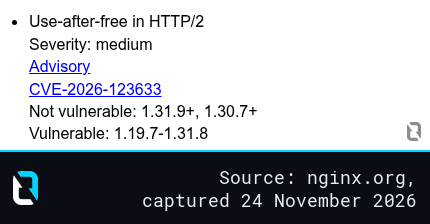
Cloudflare, writing on 20 November, says the same releases fix CVE-2026-123007, which nginx.org rates major and for which, Cloudflare says, Rapid7 has published a proof of concept. nginx.org rates CVE-2026-123633 medium, while F5 scores it 8.1 (CVSS 3.1) and 9.2 (CVSS 4.0).
The download page also lists legacy branches, the newest 1.28.3. As of that read, the saved pages show no fixed release on them, so plan to switch to the stable branch. NGINX Plus and F5's container products have their own fixed builds in F5's table, which lists Plus 37.2.0.1 and 37.0.7.1 and gives its Plus R34 to R36 row as "None". Cloudflare views R34 to R36 as affected with no fixed build and names 37.0.8.1 and 37.3.0.1. F5's table is the authority; ask F5 which build applies to you. We did not check distribution packages on 24 November, so use your distributor's own tracker to determine your exact fixed build.
Exploitation status
CISA's Known Exploited Vulnerabilities catalogue, version 2026.11.24, released at 17:47 UTC on 24 November and with 24 November as its newest added date, had no entry for CVE-2026-123633 when we read it at 23:31 UTC that day. The CVE record carries a CISA assessment dated 18 November: exploitation none, automatable no, technical impact total. Cloudflare wrote on 20 November that, as of 19 November, it had seen no reports of in-the-wild exploitation, that Xint and Wiz Research had not published their exploits, and that fake exploits were circulating on GitHub. Treat any such repository as untrusted. This can change before you read it.
Action Items
- Upgrade every NGINX that accepts HTTP/2 and proxies to a backend to the current release on your branch: 1.30.8 stable or 1.31.10 mainline, as nginx.org listed them on 24 November. nginx.org counts 1.19.7 up to the fixed releases as vulnerable to this flaw.
- Do a full restart or live binary upgrade. Unit 42 says a reload keeps the old binary running; check the running worker afterwards.
- If the upgrade must wait, review static upstream routes as well as variable ones, including grpc_pass, fastcgi_pass, uwsgi_pass and scgi_pass. Where the service allows, Unit 42 suggests disabling HTTP/2 on exposed listeners, but that can break gRPC clients, and the extra HTTP/1.1 connections may push a worker that keeps HTTP/2 on other listeners closer to its worker_connections limit. Raising worker_connections only buys headroom.
- Set error_log to warn on HTTP/2 reverse proxies and watch for "worker_connections are not enough, reusing connections". Unit 42 says it also appears under ordinary load, so it is a lead, not proof.
The question to leave on your desk is simple: which of your proxies would you have left alone because their upstream service is static?