FBI Responds to ShinyHunters' Breach Claim: What We Know
ShinyHunters claims it breached the FBI, stole employee and applicant data, and demanded changes to an official warning. The bureau is investigating, reporters have corroborated parts of a sample, and the group denies ties to “the Com”. Here is what is known and what remains unproven.


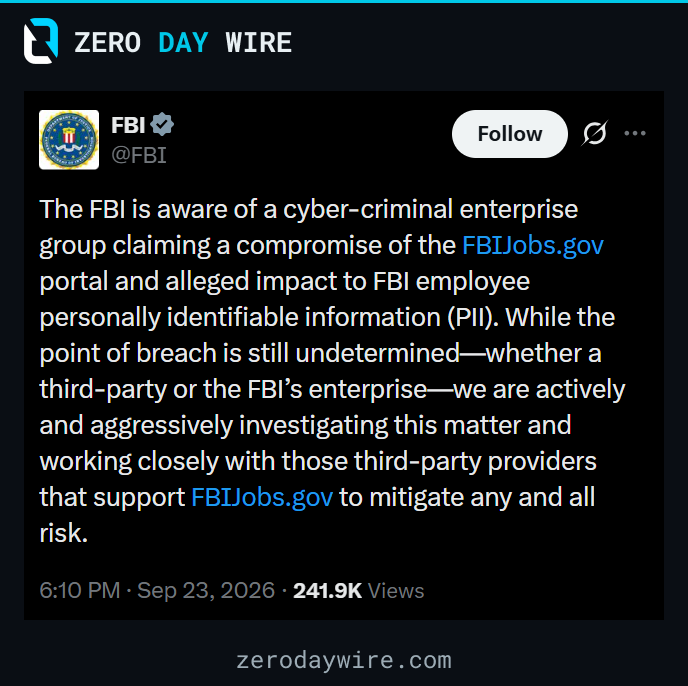
The FBI is investigating a claim that ShinyHunters stole employee and applicant information through its jobs portal. The bureau has not established whether the point of compromise was a supporting third party or its own enterprise. That uncertainty has not stopped the claim becoming a very public confrontation between a cybercrime group and the agency pursuing it.
In its 23 September statement, the FBI acknowledged the alleged impact on employee personal information and said it was working with providers supporting FBIJobs.gov. It did not confirm the attackers' claimed reach across the bureau, the volume supposedly stolen or the proposed exploitation chain.
There is evidence worth taking seriously. There is also a substantial distance between corroborating personal details in a sample and proving that an attacker obtained everything it says it did.
What the sample establishes
Joseph Cox at 404 Media first reported the claim on 22 September. ShinyHunters supplied a purported sample of 5,000 employee records. Cox matched some phone numbers to the names in the file and found associations with Justice Department personnel. That gave parts of the sample supporting evidence, not a verified origin or a complete victim count.
Reuters' initial investigation found apparent matches in at least 10 cases, including details associated with FBI Director Kash Patel. The news agency explicitly said it could not establish where the information came from or whether it had been taken from internal FBI systems.
A 23 September Reuters follow-up goes further. Reporters corroborated individual details for more than 22 people and matched career information for eight against public sources. They described sensitive assignment information and emergency contacts in the sample, but could not authenticate the whole spreadsheet or establish that all assignments were genuine and current.
That is a stronger basis for concern than an unsupported boast. It is still not confirmation that every employee or applicant is affected. A record can contain accurate information without establishing when, where or how the person presenting it obtained it. The sample's size is not the incident's confirmed scope.
Zero Day Wire has not accessed the sample or any purported leaked records. This assessment draws on the outlets' reporting, the official statement and the public posts linked here.
A jobs portal is not the whole bureau
The recruitment website is the most visible part of the story. A supplied screenshot purports to show apply.fbijobs.gov displaying a fake seizure notice under ShinyHunters' name. Reuters could not authenticate the defacement screenshot supplied to its reporters, although it independently observed a notice that the application service and Special Agent Applicant Portal were unavailable on 22 September.
The distinction matters. Disruption is observable. A screenshot records what somebody says the page displayed. Neither, on its own, establishes access to the wider FBI enterprise.

ShinyHunters told 404 Media it used an Oracle PeopleSoft zero-day, reached AWS GovCloud infrastructure and took between two and three terabytes of data. Those are the group's allegations. The reporting reviewed for this article does not establish that technical chain, and the FBI's statement leaves the entry point unresolved. Naming a cloud service is not evidence that the cloud provider itself was breached.
For defenders, the useful question is where a recruitment application can reach, which identities it uses and what copies of sensitive information sit behind it. Those are questions to test against architecture and logs, not answers supplied by an extortion post. This report does not provide a verified vulnerability identifier or a confirmed indicator set for that alleged route.
The demand is to change the warning
The stated demand is unusual: change what the FBI has said about the group. According to 404 Media, ShinyHunters gave the bureau a week to correct or remove an earlier warning and described the operation as non-financial.
The relevant FBI advisory, published on 15 May, concerns an attack on a learning management system. It warns that claims about stolen information can be real or exaggerated and describes harassment of victims and families, including swatting in some cases. It advises recipients not to pay or respond to demands, and to verify suspicious approaches through known channels.
ShinyHunters disputes that portrayal. Recorded Future News also reported that the group denied being part of "the Com", rejecting association with the wider cybercriminal community. That denial does not settle its affiliations. Its objection does not establish that the advisory was false, any more than an official warning settles the facts of this particular intrusion.
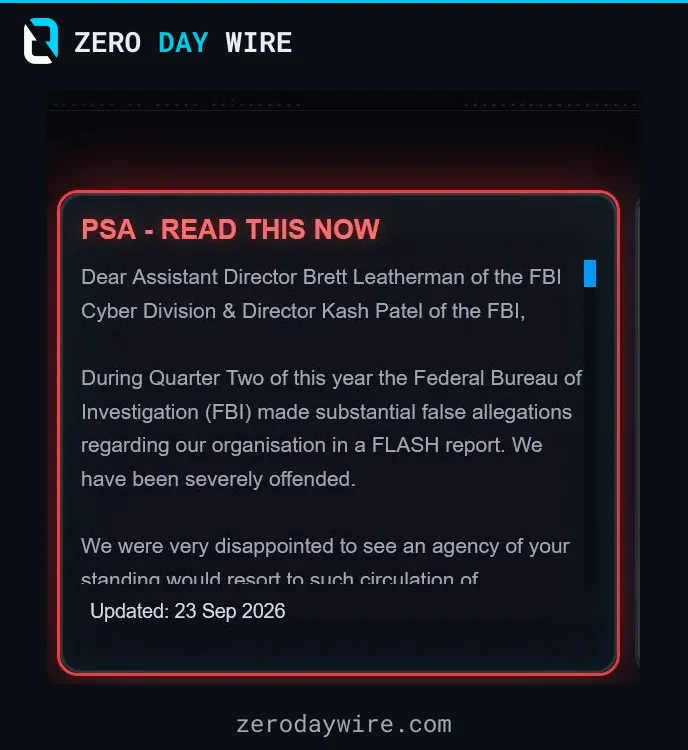
There is a further development to keep beside the original threat. Reuters' 23 September report says the group stated it would not release further data. That is an attacker statement, not evidence that records have been deleted, recovered or kept from other people. It also means the original deadline should not be presented as an unchanged, certain publication schedule.
Patel's warning is a separate post
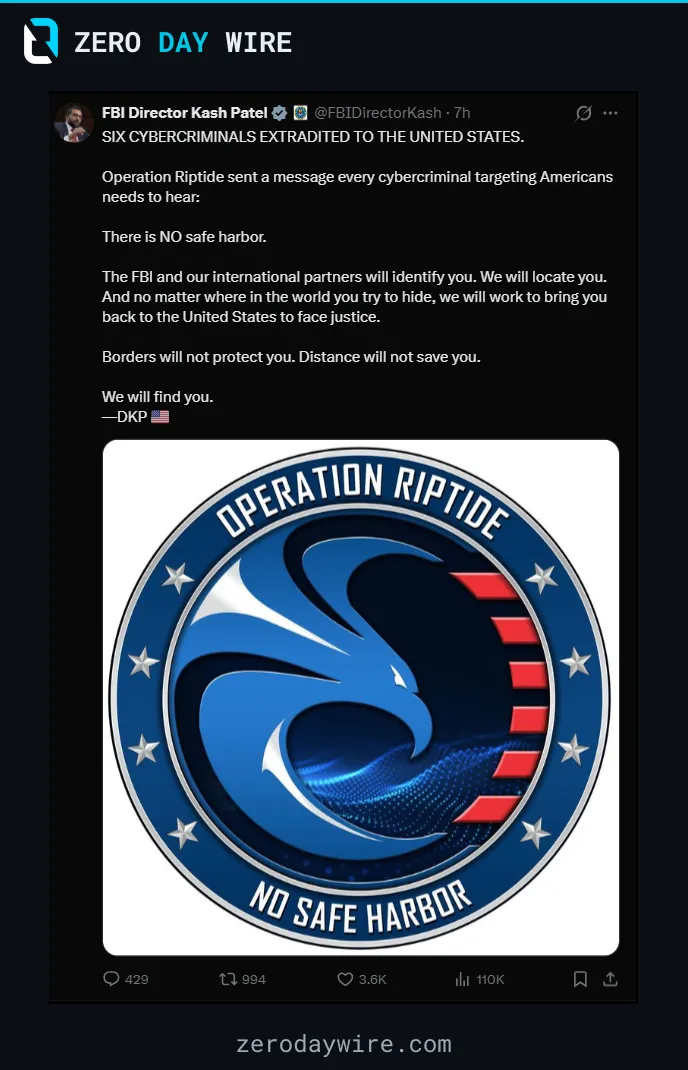
Kash Patel did post a warning to cybercriminals on 23 September. In the original post, he highlighted six extraditions under Operation Riptide and promised: "We will find you."
The post does not name ShinyHunters, discuss FBIJobs.gov or describe the alleged theft. It should not be reported as a direct reply to this incident. The agency's jobs-portal statement is the response that actually addresses the claim.
One public reply illustrates how readily readers connected the two stories. The account @Robby_Seventeen wrote: "Based on yesterday's events, I think they may have found you first."
That is an individual comment, not a representative measure of public opinion or additional evidence of a breach. It captures the reputational problem facing the bureau; it says nothing about the authenticity of a personnel record. The distinction gets lost quickly when an investigation becomes a running joke.
The records outlast the argument
For staff, applicants and their families, this is not a contest over who produced the better taunt. Information linking a person to an address, relative or sensitive role can be used to make threats and impersonation attempts more convincing. The risk does not require every claim in the attackers' announcement to be true.
Former FBI official Cynthia Kaiser, now at Halcyon, told Reuters that information from a leak dating to 2016 was still being used to harass agents. That is why a restored website or a promise not to publish more cannot, by itself, close the personnel-risk question.
The immediate practical step is to verify unexpected approaches independently. A caller knowing a real address or job detail is not proof that they represent the FBI, a recruiter or an incident-response team. Use established contact routes, preserve threatening messages and follow official incident guidance rather than links supplied by strangers offering to check whether someone is affected. Do not seek out a claimed leak to perform that check.
The investigation still needs to establish the source, age and extent of the information. Meanwhile, the public argument is already doing what the group wants: keeping attention on its claims. The people named in those claims need an answer about their exposure, not a winner in the exchange.